Best Deer Hunting Scopes Under $500 in 2026
By Peter Makulek · Senior Optics Editor · · Live prices from US retailers
Under $500 is where a deer scope stops being a compromise. Below about $200 you are mostly paying for a scope that holds zero. Between roughly $250 and $500 you start paying for the things that decide whether you get the shot: glass and coatings that stay usable in the last minutes of legal light, turrets that track, reticles designed for real hunting distances and a sturdier build. For most whitetail hunting, and a good deal of mule deer and blacktail country, there is little reason to spend more.
This guide covers how to choose within that band: which magnification and objective size suit your ground, what actually improves low-light performance, which reticle to pick, and the setup mistakes that waste a good scope. It is built around the shots deer hunters really take. For most whitetail hunters that means inside 200 yards, often inside 100, from a stand, a blind or a shooting stick.
The picks below come from our live US catalog of in-stock scopes: second focal plane models from 3-9x to 4-12x with 40mm to 50mm objectives, the classic deer configurations, so you can compare them side by side. Prices update from the retailer.
Top Picks — Live US Prices
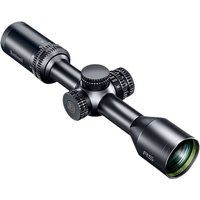
Bushnell R5 3-9x40 R5 Rifle Scope 1in, Second Focal Plane, Illuminated DOA-LRH800 Reticle, Black, R5-3940S25
via OpticsPlanet
$279.95

Bushnell R5 3-9x50mm Rifle Scope 1in, Second Focal Plane, Illuminated DOA-LRH800 Reticle, Black, R5-3950S25
via OpticsPlanet
$289.95

Bushnell R5 4-12x40mm Rifle Scope 1in, Second Focal Plane, Illuminated DOA-LRH800 Reticle, Black, R5-41240S25
via OpticsPlanet
$299.95
Buying Advice
Pick the magnification for your ground. A 3-9x covers almost every whitetail situation: 3x for a deer slipping through timber at 40 yards, 9x for a careful shot across a bean field. A 4-12x adds reach for big fields, pipelines and prairie edges, at the cost of a narrower view at the bottom end. If you hunt thick cover or still-hunt, where shots come fast and close, a 2-7x or 2.5-10x is easier to live with. Whatever you choose, leave the scope on a low or middle setting while you wait. It is far easier to find a deer at low power and turn up than to hunt for it through a narrow high-power view.
40mm or 50mm? A bigger objective gathers more light, but how bright the image looks is set by the exit pupil: the objective diameter divided by the magnification. At 9x, a 40mm scope gives a 4.4mm exit pupil and a 50mm gives 5.6mm. In the last minutes of legal light, when your own pupils are wide open, that difference is real, but mostly at the top of the zoom range. At 4x or 5x both are brighter than your eye can use. A 50mm also costs you weight and needs higher rings, which can make it harder to keep a solid cheek weld. If you hunt mostly at dawn and dusk from a stand, a 50mm is a sensible choice. If you carry the rifle all day or hunt thick cover, a 40mm balances better.
Coatings matter more than labels. In this price band, the difference you can see at dusk comes from fully multi-coated lenses, the quality of the glass and how well the scope controls stray light. Terms such as "HD" and "ED" are not used the same way by every brand, so do not choose on the label. If you can, compare scopes side by side in poor light and judge by how long you can pick out a dark shape against dark trees. That, not a daylight view in a bright store, is what a deer scope has to do.
Choose a reticle you can see in the woods. A fine crosshair disappears against dark timber at dusk. A duplex or plex reticle, with thick outer posts that lead the eye to a fine center, is the classic deer choice for good reason. BDC reticles add hold-over marks for longer shots, but they only help if you confirm where each mark lands with your own load at the distances you expect to shoot. Illumination helps in the last minutes of light, but only on its lowest settings; a bright dot at dusk blooms and hides the deer you are aiming at.
Second focal plane is the right default for deer. In a second focal plane scope the reticle stays the same size as you zoom, so it stays bold at low power, which is where most deer are shot. The hold-over marks are only correct at one magnification, usually the highest, so learn which one it is. First focal plane scopes keep the marks accurate at every power, but at 3x or 4x the reticle can shrink to a thin line that is hard to see in the woods. For a deer rifle used inside 300 yards, second focal plane is simpler.
Prefer capped turrets for most deer hunting. Exposed target turrets are easy to knock in a truck, a gun case or a stand, and a turret that has moved by a few clicks costs you the shot you waited all season for. Capped turrets with a solid 100- or 200-yard zero, plus a reticle hold when you need one, are more reliable for typical whitetail distances. If you do want to dial for longer shots, look for a zero stop and practice with it before the season, not in the stand.
Do not pay for parallax adjustment you will not use. Parallax is the apparent shift of the reticle against the target when your eye is off center, and most hunting scopes are set parallax-free at 100 or 150 yards. At normal deer distances with a centered cheek weld, the error is small. An adjustable objective or side-focus knob earns its place on a 4-12x or higher scope used for longer shots or small targets; on a 3-9x deer scope it is one more thing to fiddle with when a buck steps out.
Tube size and weight. A 1-inch tube is standard in this price band and suits most deer rifles, with a wide choice of rings. A 30mm tube gives more internal adjustment, which matters for long-range dialing more than for a whitetail zero. Weight matters more than most hunters expect: a scope, rings and base can add well over a pound to a light rifle, and a top-heavy rifle is harder to hold steady off a stick. Weigh the whole setup, not just the scope.
Get the eye relief and mounting right. Look for at least 3.5 inches of eye relief on a hard-kicking rifle, and mount the scope so you see a full picture the moment your cheek touches the stock with the power on its lowest setting. Deer rifles are shot from awkward positions, off shooting sticks, stand rails and bipods, so check the fit from those positions, not only from a bench. Torque the rings to the maker's figure and level the reticle so it is not canted.
Match the scope to the rifle. A .243, .270, .308, .30-06, 7mm-08 or 6.5 Creedmoor deer rifle is well served by a 3-9x40 or 4-12x40 on a 1-inch tube. Straight-wall cartridges such as .350 Legend and .450 Bushmaster, and slug guns, rarely need more than 9x, and a lower-power scope with generous eye relief suits them better. For long shots in open country, a 4-12x or 3-15x with a BDC or a dialing turret makes more sense.
Spend on the whole system, not only the scope. Good rings and bases, a proper zero with the exact ammunition you hunt with, and time at the range at realistic distances will do more for your success than an extra $150 of glass in loose mounts. Buy the scope, set aside money for solid mounts and a box of hunting ammunition, and zero before the season opens.
Check the scope when it arrives. Before you mount it, look through it at a distant edge in daylight and at dusk, run the magnification ring end to end, and confirm the turrets click cleanly. Once it is mounted, fire a box test: shoot a group, dial or count a set number of clicks in each direction, then return to zero and confirm the group comes back. A scope that fails that test in September will fail you in November, and it is much easier to return or replace before the season.
Rules vary by state. Some states regulate optics features in certain seasons, such as illuminated reticles or magnified scopes during muzzleloader or primitive-weapon seasons. Check your state wildlife agency's current regulations for the season you hunt. This is general information, not legal advice.
How to choose between the classic configurations. A 3-9x40 is the all-rounder for stands and mixed woods and fields. A 3-9x50 is for hunters who sit field edges at first and last light and do not mind a little more weight and taller rings. A 4-12x40 suits bigger fields, cutlines and longer shots, while still starting low enough for a close deer.
Frequently Asked Questions
What is the best magnification for deer hunting?
For most whitetail hunting, a 3-9x covers everything from close timber shots to careful shots across a field. A 4-12x suits bigger open country. Keep the scope on low to middle power while you wait, and turn it up only when you have time for a longer shot.
Is a 3-9x40 scope enough for deer hunting?
Yes. A 3-9x40 remains one of the most practical deer scopes you can buy: light, low-mounted, bright enough for legal light and with enough magnification for shots well past 200 yards. A good 3-9x40 in solid mounts is a better deer scope than a poor scope with more magnification.
Should I get a 3-9x40 or a 3-9x50 for deer?
A 3-9x50 gives a larger exit pupil at the top of the zoom range, which can help in the last minutes of legal light. A 3-9x40 is lighter and mounts lower. Choose the 50mm if you mostly sit field edges at dawn and dusk; choose the 40mm for carrying and for thick cover.
Is it worth spending $500 on a deer scope?
Spending $250 to $500 usually buys better low-light performance, more reliable turrets and a sturdier build than a budget scope. Beyond that, the gains for typical whitetail distances get smaller. Make sure you have also budgeted for good rings and time at the range.
Do I need an illuminated reticle for deer hunting?
Not always, but it helps in the last minutes of legal light against dark timber, if you keep the illumination on its lowest setting. A bold duplex-style reticle does much of the same job without batteries. Check whether your state restricts illuminated reticles in any season you hunt.
What range should I zero my deer rifle at?
A 100-yard zero is simple and easy to confirm. Many hunters with flat-shooting cartridges prefer a 200-yard zero, which keeps the bullet within a few inches of the aim point out to typical deer distances. Whichever you choose, confirm it with the exact ammunition you hunt with and know your holds at 250 and 300 yards.
First or second focal plane for a deer rifle?
Second focal plane suits most deer hunters, because the reticle stays bold at low power, where most deer are shot. First focal plane makes more sense if you dial or use hold-over marks at several magnifications for long shots in open country.
Related guides
Find the best hunting scope for deer under $200 in 2026. We cover top picks for whitetail stands, low-light timber, and Western upgrades…
How Much Magnification Do You Actually Need for Tree-Stand Whitetail?Discover exactly how much scope magnification you need for tree-stand whitetail hunting. We break down power ranges, FOV…
Best Scope for 300-Yard Hunting Shots in 2026What scope magnification do you need for 300 yards? Real 2026 US prices on the Vortex Crossfire HD and Diamondback, plus holdover and parallax advice.
Best Scopes for .30-06 Springfield (2026)Find the best scope for your .30-06 Springfield in 2026. Recoil-proof construction, ideal magnification for 400-yard shots…
Best 6.5 Creedmoor Scopes Under $500 in 2026Find the best scope for 6.5 Creedmoor under $500 in 2026. We cover FFP vs SFP, MOA vs MRAD, long-range picks, and ideal pairings for Tikka, Savage…
FFP vs SFP Scopes ExplainedFFP vs SFP explained: how reticle subtensions hold at every magnification, which disciplines favor each, and why FFP costs more. A 2026 buyer's guide.
Best Rangefinder Binoculars for Deer Hunting in 202610x42 rangefinder binoculars for deer hunting, from about $390. Deer vs reflective range, angle compensation, prisms and IP ratings explained.
Best Thermal Monoculars for Hunting in 2026Thermal monoculars for hogs, coyotes and deer recovery, from about $540. Sensor resolution, NETD, detection range and battery life explained.
Not sure which scope is right for you?
Try our AI-powered scope finder — answer a few questions and get personalised recommendations.
Find My Scope →Get a scope tip every day
Follow AiScopes on Facebook for daily buying guides, deals and gear advice.
Follow on Facebook