The ATN Thor 5 LRF pairs a 640×480 Gen 5 sensor with a 12-micron pixel pitch, a built-in laser rangefinder, and ATN's Smart HD feature set (onboard recording, Wi-Fi streaming, and a ballistic calculator that can apply holdover automatically once you've ranged your target). The 3-24x magnification range is genuinely versatile — low enough to acquire a coyote breaking cover at 50 yards, high enough to positively identify and place a shot on a hog at 300+ yards across an open field. It's the scope we'd point most serious dual-purpose (coyote and hog) buyers toward first, provided the ~$3,000 price point fits the budget.
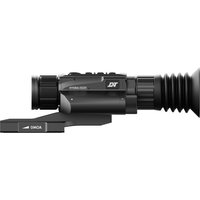
At $999.99 (sale price, $1,199.99 list), the DNT Optics Hydra HS225 gives you a real, usable 256×192 thermal sensor rather than a compromised digital-NV substitute. A 256-class sensor won't match a 640 unit for fine detail at range, and this tier has no built-in rangefinder, but for calling stands inside 150-200 yards — the majority of coyote engagements — it's genuinely capable, and it's a sensible way to try thermal hunting before committing to a $3,000+ rig.
AGM's "Varmint" line is aimed squarely at predator hunters, and this SKU backs that up: a 35mm objective and a 3x base magnification (3-24x digital) built for scanning wide-open pasture and picking a coyote out at genuine distance, paired with a built-in laser rangefinder for accurate holdover on longer calling-stand shots. The tradeoff for that reach is a 384×288 sensor rather than the sharper 640-class chip, which suits open Western and High Plains coyote country better than thick cover.
The same "Varmint V2 LRF" line also ships this variant with a 640×512 sensor — noticeably sharper than its 384-class sibling above — paired with a lower 2-16x magnification range and the same 35mm objective as its 384-class sibling. That combination is a better match for hog hunting, where shots often happen at closer range in brush or along field edges and you need enough resolution to sort a boar from a sow in a moving sounder before you commit to a shot. The integrated LRF is genuinely useful here too, since hogs frequently present quartering shots where precise range matters for shot placement.
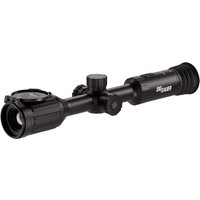
For landowners and guides running serious, high-volume hog-control operations, the Sig Sauer Echo RV50-LRF steps up to a 640×512 sensor, a 50mm objective, a 50 Hz refresh rate, and a built-in laser rangefinder in one package. Sig's ballistic-integration pedigree (from its BDX line of day optics) carries over here, and the 50mm objective genuinely improves image quality and low-light gathering over the smaller-objective options above. If budget allows, this is the pick for anyone shooting several nights a week rather than the occasional calling stand. Buyers wanting to go even further upmarket should also look at Trijicon's IR-HUNTER line, which pushes into the $6,000+ range with premium glass and thermal-imaging pedigree built originally for military and law-enforcement use.
If the standard Thor 5 LRF's ~$3,079 price tag is a stretch, the non-LRF ATN ThOR 5 640 3-24x is listed on ATN's own site at $2,895, giving up the built-in rangefinder for a lower price. It's worth cross-shopping before you commit to the full-price model. At the true entry level, the Sightmark Shade 3.5-28x30 (~$1,000) is a compact, budget-class 256-sensor option worth a look if you want something lighter than a full-size thermal for a lease rifle that only comes out occasionally.
A thermal clip-on mounts ahead of your existing day scope, letting you keep your familiar reticle, magnification range, and zero — you simply flip the clip-on's power on and see a thermal image through your day glass. That's genuinely valuable if you already run a good LPVO or hunting scope on your rifle and don't want to re-zero every time you switch between day and night hunting. The tradeoffs are real, though: clip-ons add significant length and weight forward of your day scope, require enough eye relief and objective clearance to mount cleanly, and pass the thermal image through an extra optical path, which can cost you some sharpness versus a dedicated unit at the same price. Well-regarded brands like Pulsar build clip-on thermal front modules that pair with existing riflescopes, typically positioned in the $2,000-$5,500+ range depending on sensor class.
A dedicated thermal scope, like every product picked above, is a standalone sighting system: no day optic underneath, one battery to manage, and generally better image quality per dollar since there's no compound optical path. The tradeoff is that you need to re-zero (or run a second rifle/mount) if you also want a conventional day scope, and you lose the ability to hunt during daylight hours on that same setup unless the unit has a digital day mode. For a dedicated night-hunting rig — which describes most serious coyote and hog setups — a dedicated thermal scope is usually the better buy. Reserve clip-ons for hunters who genuinely need one rifle to do both day and night work interchangeably.
Sensor resolution sets the ceiling on how much detail you can resolve at range. At the entry level you'll see 256×192 sensors; the mid tier moves to 384×288; premium units use 640×512 or, on a handful of top-end models, 1280×1024. Going from 256 to 384 is a meaningful jump in image clarity; 384 to 640 is an even bigger one, and it's the difference that lets you confidently sort a boar from a sow at 150 yards rather than guessing. Pixel pitch (commonly 12 or 17 microns in this category) trades sensitivity for compactness — a smaller pitch packs more resolution into a given sensor size but can need slightly better optics to make full use of it. NETD (Noise Equivalent Temperature Difference), measured in millikelvins, tells you how small a temperature difference the sensor can register; under 40 mK is good, under 25 mK is excellent for picking out a coyote against a cool background. Refresh rate matters more for predator hunting than almost any other discipline — a 50 Hz sensor tracks a running coyote or a spooked hog smoothly, while 25-30 Hz visibly stutters when you pan quickly.
Under $1,000, expect a 256-class sensor, a smaller objective (around 25mm), no built-in rangefinder, and genuinely usable performance for calling stands and hog fields inside roughly 150-200 yards — the DNT Optics Hydra and Sightmark Shade above are solid examples. From roughly $2,000 to $3,200, you move into 384-to-640-class sensors with integrated laser rangefinders and 50 Hz refresh becoming standard, with confident coyote identification extending out to 300+ yards — this is where most serious dual-purpose coyote/hog hunters land, and where the ATN Thor 5 LRF and both AGM Varmint V2 variants sit. Above $4,000, you're paying for larger 50mm+ objectives, top-tier 640×512 sensors, and glass/build quality aimed at hunters and outfitters running the scope hard, multiple nights a week, year-round — the Sig Sauer Echo RV50-LRF and Trijicon's IR-HUNTER line represent this tier.
The single most common mistake is buying purely on a manufacturer's headline detection-range figure, which measures when a heat signature first appears on screen — not when you can confidently identify what it is. Identification range for a coyote-sized target typically runs at only one-quarter to one-third of the advertised detection distance, so a scope claiming 1,500 yards detection might realistically deliver confident coyote identification closer to 375-500 yards. The second common mistake is under-shopping magnification range for the job: a scope with too little top-end zoom struggles on open-pasture coyote calling, while one with too little bottom-end (a high minimum magnification) makes fast, close shots on hogs breaking from cover genuinely difficult. Third, don't ignore battery life — a cold winter night hunt easily runs four-plus hours, and a scope that dies mid-stand is a real liability; prioritize USB-C charging and carry a spare battery. Finally, remember that a thermal scope is a sighting system, not a substitute for correct caliber and shot placement — thermal helps you find and identify game, it doesn't compensate for an underpowered round on a big boar.
If you primarily call coyotes on open ranchland or ag fields, prioritize magnification reach and a built-in rangefinder — the AGM Varmint V2 LRF 35-384 (3-24x digital) or the ATN Thor 5 LRF's 3-24x range both serve that use case well, since most of your engagement decisions happen well past 150 yards. If your work is hog control in thick cover, creek bottoms, or agricultural edges, prioritize sensor resolution and a lower minimum magnification over raw zoom — the 640-class AGM Varmint 2-16x35mm variant is built for exactly that. Hunters doing genuinely mixed work (a lease that runs both coyote calling stands and hog control) should lean toward a 640-class sensor in a moderate 2-16x or 3-24x range, since resolution helps in both scenarios more consistently than magnification alone.
Rules around hunting coyotes and feral hogs at night with thermal optics vary significantly by state, and in some cases by county or specific wildlife management unit — always verify current regulations with your state wildlife agency before hunting. As a general pattern, coyotes are classified as an unprotected or nuisance predator species in most states, and many states permit night hunting of coyotes with thermal or night-vision equipment, sometimes with a permit or during a defined season. Feral hogs are non-native, invasive, and cause severe agricultural damage across much of the South (Texas, Oklahoma, Georgia, Florida, Alabama, Mississippi, Louisiana, and others), and several of these states allow night hunting of hogs with thermal optics on private land with landowner permission and no bag limit or closed season — Texas is the most permissive example. Other states restrict night hunting, artificial light, or thermal-equipped firearms use much more tightly, or require specific depredation permits. Do not assume your home state's rules for one animal apply to the other, and never assume rules transfer across state lines on a hunting trip.
ATN is the highest-volume US thermal-scope brand at the consumer level, with the Thor line spanning entry-level to premium and a strong track record of onboard smart features (ballistic calculators, video recording, app connectivity). AGM Global Vision has built specific credibility with predator hunters through its Varmint-branded line, aimed directly at coyote and hog use cases, alongside a broader thermal and digital-NV catalog. Sig Sauer entered thermal more recently through its Echo line, leaning on the electronics and ballistics-integration reputation it built with day optics like the BDX series, and generally competes at the premium end. Pulsar remains a well-regarded name for both dedicated thermal scopes and clip-on front modules, particularly popular for hunters who want to add thermal capability to an existing day-scope setup. Beyond these established names, a wave of budget-focused newer entrants has moved into the sub-$1,000 thermal space chasing cost-conscious predator hunters who want a lower entry price than the mainstream brands. Treat any specific newer brand as worth researching directly and reading current, dated owner reviews before buying — these companies can move quickly on price and features but generally have a shorter track record for long-term reliability, firmware support, and warranty service than ATN, AGM, Pulsar, or Sig Sauer.