Nikon Rimfire Scopes: What Happened & What to Buy Instead
By Peter Makulek · Senior Optics Editor · · Live prices from US retailers
Quick answer: Nikon's Prostaff Rimfire line was one of the best value rimfire scopes ever made, but Nikon exited the riflescope market in 2019. If you can still find new-old-stock at a fair price, the 3-9×40 BDC 150 remains a solid buy. Otherwise, the Vortex Crossfire II 2-7×32 Rimfire and the Leupold VX-Freedom Rimfire 3-9×40 are the two closest modern replacements, offering dedicated .22LR turrets or reticles, quality glass, and strong warranties.
Nikon's departure left a real hole in the rimfire optics market. The Prostaff Rimfire II, with its BDC 150 reticle calibrated for standard-velocity .22LR out to 150 yards, offered a level of thoughtful engineering at a sub-$200 price that was hard to beat. The glass was sharp, the adjustments were positive, and the parallax was factory-set at 50 yards — the sweet spot for most rimfire shooting. US shooters who still have one mounted on a Ruger 10/22, CZ 457, or Savage Mark II know exactly how good it was. For those needing a replacement or building a new rimfire rig, the landscape has changed but arguably improved.
One reason the Nikon rimfire question keeps coming up is that .22LR shooting in the US is booming. PRS Rimfire competitions are growing in nearly every state, benchrest rimfire leagues are thriving, and plinking remains the most affordable way to stay sharp. A quality rimfire scope needs specific features: fine adjustment resolution (preferably 1/4 MOA or 0.1 MRAD), parallax-free performance at short distances (typically 25 to 75 yards), and a reticle that works well at low magnification. These requirements differ meaningfully from centerfire optics, and not every scope marketed as a 'rimfire' model actually meets them.
In this guide we break down what made the Nikon rimfire scopes special, identify the closest modern alternatives across multiple budget tiers, and answer the specific questions US rimfire shooters are asking — from PRS Rimfire competition glass to benchrest-grade optics and affordable plinkers. Whether you are looking for a scope under $150 for a youth rifle or a premium FFP optic for competitive rimfire, we have you covered.
Top Picks — Live US Prices

Barska 4X20 Rimfire Rifle Scope, Black Matte AC10730
via OpticsPlanet
$18.99
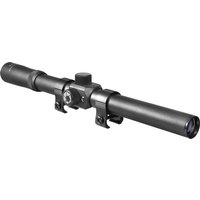
Barska 4x15 Rimfire Rifle Scopes - AC10000 Rifle Scope
via OpticsPlanet
$22.99

Simmons Pro Rimfire 4x32mm Rifle Scope with Rings, Black, Small, SPR432
via OpticsPlanet
$55.99
Buying Advice
When evaluating any rimfire scope, start with three specs: parallax setting, adjustment granularity, and reticle suitability. Factory-set parallax matters enormously at rimfire distances. A centerfire scope set at 100 or 150 yards will show significant parallax error at 25–50 yards, causing groups to open up and shift with eye position. Look for scopes with parallax fixed at 50 yards or, better yet, adjustable (side-focus) parallax down to 10 or 25 yards. Adjustment resolution of 1/4 MOA (roughly 0.26 inches at 100 yards) or 0.1 MRAD (1 cm at 100 meters, or about 0.36 inches at 100 yards) ensures you can make precise zero corrections. Magnification of 4–16× or higher is ideal for precision disciplines, while 2–7× or 3–9× suits general plinking and small-game hunting.
Budget tiers in 2026 break down clearly. Under $150, Vortex's Crossfire II 2-7×32 Rimfire and Bushnell's Banner 2 3-9×40 are solid entry points with good glass, lifetime warranties, and rimfire-appropriate parallax settings. In the $150–$350 mid-tier, the Leupold VX-Freedom Rimfire 3-9×40, Vortex Diamondback Tactical 4-16×44, and Bushnell Match Pro 6-24×50 offer substantially better glass clarity, more precise turrets, and features like side-focus parallax. Above $350, premium options from Nightforce (the NXS Compact), Vortex (Razor HD LHT), and Leupold (VX-3HD) deliver competition-grade tracking, elite optical coatings, and the mechanical repeatability that PRS Rimfire and benchrest shooters demand. Each tier jump buys you better glass, tighter turret tolerances, and more reliable repeatability.
The most common mistake rimfire buyers make is mounting a leftover centerfire hunting scope on a .22LR rifle. Beyond the parallax mismatch discussed above, many hunting scopes have thick reticles (duplex-style) that obscure small targets at 50–100 yards and capped turrets not designed for frequent adjustment. Another frequent error is over-scoping: putting a heavy 6-24× optic on a lightweight 10/22 makes the rifle front-heavy and awkward. Match scope weight and magnification to your platform. A third mistake is ignoring scope ring height — rimfire rifles with rail-mounted receivers (like the CZ 457 or Bergara BMR) often need low or medium rings, and a 50mm objective on low rings can contact the barrel. Measure before you buy.
For US-specific context, Amazon.com and OpticsPlanet are the two largest online sources for rimfire optics, and both carry the full Vortex, Leupold, and Bushnell rimfire lines. Brick-and-mortar options abound — use the dealer locator at aiscopes.us to find a local shop that lets you handle scopes before buying. PRS Rimfire matches, sanctioned by the Precision Rifle Series, are held across all 50 states and are the fastest-growing segment of competitive shooting in the US. Benchrest rimfire, governed by organizations like the American Rimfire Association (ARA), has its own scope requirements — typically higher magnification (16× minimum) and extremely repeatable turrets. Both disciplines overwhelmingly use .22LR, making scope selection around that cartridge's trajectory and energy profile critical.
Matching the scope to your use case is the final step. For casual plinking and small-game hunting at 25–75 yards, a 2-7× or 3-9× with a simple BDC or duplex reticle and fixed 50-yard parallax is perfect — keep it light and simple. For PRS Rimfire competition, you need a first-focal-plane (FFP) scope in the 4-16× to 5-25× range with exposed turrets, MRAD or MOA hash-mark reticle, side-focus parallax adjustable to 25 yards, and verified tracking. For rimfire benchrest, second-focal-plane (SFP) scopes at 24× or higher with fine crosshairs, adjustable parallax, and rock-solid repeatability are the norm. For varmint and pest control, consider whether a thermal scope from Pulsar or HikmicroMicro might complement your daylight rimfire optic for night work — thermal units starting around $1,500 are increasingly popular among US predator and pest hunters.
On the brand landscape: Vortex dominates the US rimfire market with its unconditional lifetime warranty and broad product line from budget to premium. Leupold remains the gold standard for American-made quality, with the VX-Freedom Rimfire being their most popular .22LR offering. Bushnell has surged with the Match Pro line, offering competition-tier features at mid-tier prices. Nightforce and Zeiss serve the premium end — outstanding glass and mechanics, but at price points that only competitive shooters or serious enthusiasts typically justify for a rimfire platform. Weaver still has a loyal following, though their rimfire-specific lineup is smaller. Nikon's legacy lives on in the used market, and a well-kept Prostaff Rimfire II remains a perfectly serviceable scope — just know that warranty service is no longer available.
Frequently Asked Questions
Are Nikon rimfire scopes still being made?
No. Nikon announced its exit from the riflescope and sportoptics market in 2019, and production of all Prostaff Rimfire models has ceased. You can occasionally find new-old-stock online through Amazon.com or smaller dealers, but supplies are dwindling and prices are rising. Nikon no longer offers warranty service on these scopes, so buying used carries some risk.
What is the best scope for PRS Rimfire competition?
For PRS Rimfire, you want a first-focal-plane (FFP) scope with 4-16× or 5-25× magnification, exposed turrets with precise 0.1 MRAD or 1/4 MOA clicks, side-focus parallax adjustable down to 25 yards, and a hash-mark reticle for holdovers. The Vortex Diamondback Tactical 6-24×50 FFP and Bushnell Match Pro 6-24×50 are popular mid-tier choices. Premium competitors often run the Nightforce NXS Compact or Vortex Razor HD LHT. Verified tracking and turret repeatability are more important than raw magnification in this discipline.
What is the best scope for rimfire benchrest?
Rimfire benchrest demands the highest magnification and the finest reticle you can get — typically 24× or higher in a second-focal-plane (SFP) configuration with a thin crosshair. Adjustable parallax down to 25 yards is essential, as benchrest shooting often occurs at 50 yards. Leupold Competition series scopes, Nightforce Benchrest models, and Weaver T-Series have long been staples. Mechanical repeatability — the ability to return precisely to zero after dialing — is the single most critical attribute for this discipline.
What replaced the Nikon Prostaff Rimfire scope?
The closest direct replacement in terms of price, features, and intended use is the Vortex Crossfire II 2-7×32 Rimfire, which offers a dedicated rimfire reticle, 50-yard parallax setting, and Vortex's unconditional lifetime warranty at a similar price point. The Leupold VX-Freedom Rimfire 3-9×40 is a step up in glass quality and carries Leupold's lifetime guarantee. Both are widely available on Amazon.com and at US sporting goods retailers.
Do I need a dedicated rimfire scope or can I use a regular rifle scope?
A dedicated rimfire scope is strongly recommended. Standard centerfire rifle scopes typically have parallax set at 100 yards or more, which causes aiming errors at the 25–75 yard distances common in rimfire shooting. Dedicated rimfire scopes also often feature BDC reticles calibrated for the .22LR's rainbow-like trajectory and turrets scaled for the smaller adjustments rimfire shooters need. You can use a centerfire scope with adjustable parallax (side focus), but you will lose the rimfire-specific reticle benefits.
What scope magnification do I need for .22LR shooting?
It depends on your use case. For plinking and small-game hunting at 25–75 yards, 2-7× or 3-9× is plenty. For steel challenge and action rimfire matches, a low-power variable optic (LPVO) at 1-6× or even a red dot works well. For PRS Rimfire at 25–100+ yards, 4-16× or 6-24× in FFP is standard. For benchrest, 24× and above is preferred for resolving tiny group sizes. More magnification is not always better — higher power narrows your field of view, amplifies mirage, and adds weight.
What scope rings should I use on a rimfire rifle?
Most rimfire rifles use either 3/8-inch dovetail mounts (common on Ruger 10/22, Marlin, and many youth rifles) or Picatinny/Weaver rails (found on CZ 457, Bergara BMR, Tikka T1x, and aftermarket-equipped 10/22s). Make sure your rings match the mounting system on your rifle. For objective lenses of 32mm or smaller, low rings usually provide adequate clearance. For 40mm or 50mm objectives, measure carefully — bell-to-barrel clearance should be at least 1/8 inch. Lightweight aluminum rings from Vortex, Leupold, or Weaver are ideal for rimfire platforms.
Can I use a thermal or night vision scope on a rimfire rifle?
Yes, and it is increasingly popular for pest control and predator hunting. Thermal scopes from Pulsar (Thermion 2) and Hikmicro (Thunder series) mount on rimfire rifles and are effective for detecting rats, squirrels, and raccoons at ranges where .22LR is lethal — typically inside 75 yards. Night vision digital scopes from Sightmark and Pulsar also work well. Check your state's regulations, as some states restrict the use of thermal and night vision optics for hunting certain species.
Is it worth buying a used Nikon Prostaff Rimfire scope in 2026?
If you find one in good condition at a fair price, it can still be an excellent scope. The glass quality and BDC 150 reticle remain competitive with current sub-$200 options. However, keep in mind that Nikon no longer services or warranties these scopes, so any mechanical failure means the scope is effectively unrepairable. Inspect the turrets, glass clarity, and parallax adjustment carefully before purchasing. A new Vortex Crossfire II Rimfire with a lifetime warranty may be a safer long-term investment.
Related guides
Find the best scope for long-range rimfire shooting on a CZ 457 Varmint MTR. We cover FFP reticles, turret quality, parallax…
Best Scopes for the CZ 457 in 2026Find the best scope for your CZ 457 in 2026. We cover budget, mid-tier, and PRS-rimfire competition optics with adjustable parallax, turret quality…
Best Scopes for .22 WMR in 2026Find the best scope for 22 Magnum in 2026. US buyer's guide covers parallax, magnification, budget picks, and top optics for bolt-action and lever-action .
New Optic Day for Your Ruger 10/22 CarbonFind the best scope for your Ruger 10/22 Carbon in 2026. We cover rimfire optics, FFP vs SFP, parallax, and top picks for squirrel hunting, benchrest…
Not sure which scope is right for you?
Try our AI-powered scope finder — answer a few questions and get personalised recommendations.
Find My Scope →Get a scope tip every day
Follow AiScopes on Facebook for daily buying guides, deals and gear advice.
Follow on Facebook