Budget Scopes That Survive the Gamo Viper Storm .22
By Peter Makulek · Senior Optics Editor · · Live prices from US retailers
The Gamo Viper Storm in .22 caliber is a popular, hard-hitting break-barrel springer that delivers respectable downrange energy for pest control and backyard plinking. But there is a catch that surprises many first-time owners: spring-piston air rifles produce a unique double-pulse recoil — a sharp forward lunge followed by rearward kick — that destroys scopes designed exclusively for centerfire or rimfire firearms. Standard rifle scopes expect recoil in one direction only, and the violent bidirectional jolt of a magnum springer will shatter reticle wires, strip turret teeth, and shift zero in a matter of a few hundred shots. If you have already gone through one scope, you are not alone.
Choosing a budget scope for the Viper Storm means looking specifically for optics rated for spring-piston air rifles or those with a proven track record of surviving reverse recoil. Price alone is not the deciding factor — a $40 scope built with the right internals will outlast a $200 hunting scope that was never engineered for the stress pattern a springer creates. The good news is that several manufacturers now offer scopes in the $50 to $150 range that handle these forces reliably, and some higher-end brands like Vortex back their products with unconditional lifetime warranties that effectively guarantee you are covered regardless.
Because the Gamo Viper Storm .22 is realistically a 30- to 50-yard platform — with a practical maximum of about 75 yards under ideal conditions — you do not need extreme magnification or long-range turret travel. What you do need is a scope with a clear reticle at moderate power, reliable parallax correction at short distances, and construction robust enough to hold zero through thousands of shots. An adjustable objective (AO) or side-focus parallax knob set down to 10 yards is far more important here than a first focal plane reticle or MIL-spec turret system.
This guide is written for US-based shooters buying from retailers like Amazon.com and OpticsPlanet. We will walk you through the key specifications that matter for a springer scope, recommend proven models across several budget tiers, explain common mistakes that cost people money, and answer the most frequently asked questions we see from Gamo owners online. Whether you are setting up a Viper Storm for squirrel duty in your backyard or controlling pests on a rural property, the right scope makes this rifle dramatically more effective — and the wrong one is just an expensive lesson.
Top Picks — Live US Prices

Barska 4X20 Rimfire Rifle Scope, Black Matte AC10730
via OpticsPlanet
$18.99
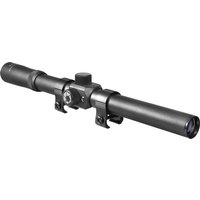
Barska 4x15 Rimfire Rifle Scopes - AC10000 Rifle Scope
via OpticsPlanet
$22.99

Simmons Pro Rimfire 4x32mm Rifle Scope with Rings, Black, Small, SPR432
via OpticsPlanet
$55.99
Buying Advice
The single most important specification for a Gamo Viper Storm scope is whether the optic is rated for spring-piston or gas-ram air rifles. Look for explicit language such as "airgun rated," "spring-piston compatible," or "withstands reverse recoil" in the product description. Internally, these scopes use a one-piece tube, heavier reticle wire or etched-glass reticles, and locking turret mechanisms that resist the forward lunge unique to springers. Magnification in the 3-9x or 4-12x range is ideal — going higher than 16x on a platform effective to 50-75 yards simply amplifies mirage and wobble without adding practical precision. An adjustable objective lens that goes down to 10 yards eliminates parallax error at the close distances where you will actually shoot, which matters far more than it does on a centerfire hunting rifle zeroed at 100 yards.
Budget tiers break down clearly. Entry-level springer scopes in the $30 to $60 range — such as Gamo's own bundled optics or basic UTG/Leapers models — will survive the recoil but often have mediocre glass clarity and imprecise turret adjustments. The mid-tier sweet spot sits between $60 and $150: this is where you find optics like the Hawke Vantage or the Bug Buster series with genuinely good coatings, finger-adjustable turrets with repeatable clicks, and solid AO parallax systems. Premium airgun scopes from $150 to $300, including select Vortex Diamondback and certain Leupold rimfire models, bring superior edge-to-edge clarity and unconditional warranties, though for most Viper Storm users the mid-tier range delivers the best value for money.
The most common mistake buyers make is mounting a standard centerfire hunting scope and expecting it to last. Even well-regarded brands like Leupold, Zeiss, and Nightforce design their mainline products to handle rearward-only recoil, and their warranties may not cover damage from a spring-piston airgun. The second common error is using two-piece rings instead of a one-piece mount or arrestor-pin setup — the Gamo's dovetail rail allows the scope to creep forward under recoil unless physically stopped. Always use a scope stop pin or a mount with a built-in recoil arrestor. Third, many shooters over-magnify: cranking a 4-16x scope to 16x on a springer makes it nearly impossible to hold steady offhand, and the narrow field of view at high power makes acquiring small pests slower, not faster.
For US shooters, the Gamo Viper Storm .22 fills a practical niche: backyard pest control where discharging a rimfire or centerfire may be restricted by local ordinances or neighborhood proximity. Most states treat sub-12 ft-lb air rifles as unregulated, though a handful of municipalities have specific rules — check your local code before shooting in a residential area. When buying your scope, Amazon.com offers the widest selection and competitive pricing with easy returns, and OpticsPlanet is another reliable US retailer that often stocks airgun-specific optics and mounting hardware. Both ship to all 50 states without the FFL complications associated with firearms.
Matching the scope to your actual use case is straightforward. If you are primarily plinking at paper and steel spinners in the backyard at 20-35 yards, a simple 4x32 fixed-power scope with a duplex reticle is light, clear, and almost indestructible — and it keeps costs under $50. If you are shooting pests like squirrels, rats, or starlings and need to place pellets precisely into a dime-sized kill zone at 40-60 yards, step up to a 3-9x40 or 4-12x40 with an AO lens and a mil-dot or BDC reticle that gives you holdover references for your pellet's trajectory. Thermal and night-vision scopes exist for air rifles, but they start well north of $500 and are overkill — both in cost and capability — for a break-barrel springer in this class.
On the brand landscape, Vortex stands out for US airgun shooters because of their unconditional VIP warranty — if your scope fails for any reason, including springer recoil damage, they replace it with no questions asked and no receipt required. That policy effectively turns any Vortex Crossfire II or Diamondback into a springer-safe optic by default, even though they are not explicitly airgun-rated. Hawke is the specialist brand most recommended in the airgun community and offers purpose-built models with airgun-specific reticles. Burris and Weaver offer some budget-friendly options, though fewer are explicitly springer-rated. Leupold's rimfire scopes can work but lack the AO adjustment range many airgunners prefer. Meopta, March, and Nightforce sit at price points that exceed what makes sense for a budget springer setup, though their optical quality is extraordinary if budget is not the constraint.
Frequently Asked Questions
Why does my Gamo Viper Storm keep breaking scopes?
Spring-piston air rifles produce a unique double-pulse recoil: the piston slams forward first, then the rifle kicks rearward. This bidirectional shock is far more destructive to scope internals than the single rearward pulse of a firearm. Standard rifle scopes have reticle assemblies and erector tube springs designed to resist force in one direction only, so the forward jolt shatters wires, strips turret gears, and shifts zero. You need a scope specifically rated for spring-piston or gas-ram air rifles, or one backed by an unconditional warranty like the Vortex VIP guarantee.
Can I use a rimfire scope on a break-barrel air rifle?
Not reliably. Rimfire scopes are built for the very light, rearward-only recoil of a .22 LR — typically under 1 ft-lb of felt recoil. A magnum springer like the Gamo Viper Storm generates a much more violent and bidirectional jolt that rimfire scope internals are not engineered to handle. While some rimfire scopes may survive for a while, they tend to lose zero or suffer internal damage over hundreds of shots. Purpose-built airgun scopes or unconditionally warrantied optics are the safer choice.
What magnification range is best for a .22 cal air rifle scope?
For a break-barrel springer like the Viper Storm, a 3-9x or 4-12x variable scope covers every practical scenario. The .22 caliber pellet is effective to roughly 50-75 yards in this platform, and higher magnification only amplifies shooter wobble and heat mirage without adding useful precision. A 9x setting gives you a clear view of a squirrel-sized target at 50 yards with enough field of view to acquire it quickly. Fixed 4x scopes are excellent for closer-range plinking and pest control under 35 yards.
Do I need a first focal plane (FFP) or second focal plane (SFP) scope for an air rifle?
For airgun use, a second focal plane scope is the better choice and is also much more common at budget price points. FFP reticles maintain accurate subtension-based holdovers at every magnification, which matters for long-range precision shooting — but at the 20-75 yard distances where an air rifle operates, this advantage is negligible. SFP scopes keep the reticle at a consistent, visible size regardless of magnification, which makes target acquisition easier in the field. Save the FFP premium for a centerfire precision rig where it truly pays off.
Should I choose MOA or MRAD turrets for an airgun scope?
Either system works fine at airgun distances, but MOA is slightly more intuitive for most US shooters because 1 MOA equals approximately 1.047 inches at 100 yards — easy mental math. At 50 yards, one MOA click moves your point of impact roughly half an inch. MRAD (milliradian) turrets, where 0.1 mil equals 1 centimeter at 100 meters, are the standard in precision rifle competition but offer no practical advantage at typical springer engagement distances. Choose whichever system you are already comfortable with.
What is adjustable objective (AO) parallax and why does it matter on an air rifle?
Adjustable objective parallax lets you focus the scope's internal image at a specific distance, eliminating the apparent shift of the reticle against the target when your eye is not perfectly centered. Most centerfire scopes are parallax-set at 100 or 150 yards, which means at 25-50 yards the parallax error can move your point of impact by an inch or more — a huge miss on a small pest target. Airgun-rated scopes with AO typically adjust down to 10 yards, ensuring parallax-free aiming at the exact distances where you shoot.
Will a Vortex Crossfire II survive on a Gamo springer?
Many airgunners report running a Vortex Crossfire II on magnum springers for thousands of shots without failure. While Vortex does not explicitly rate the Crossfire II for spring-piston recoil, their unconditional VIP lifetime warranty means they will replace it if it does fail, no questions asked and no receipt needed. This makes the Crossfire II a popular and effectively risk-free choice for budget-conscious springer owners in the US. Pair it with a one-piece mount and a scope stop pin for the best results.
How do I stop my scope from creeping forward on the Gamo's rail?
The Gamo Viper Storm uses an 11mm dovetail rail, and the forward recoil pulse pushes the scope mount toward the muzzle over time — a problem called scope creep. The fix is a scope stop pin: a small metal pin that drops into one of the holes on the Gamo's rail and physically blocks the mount from sliding forward. Many one-piece airgun mounts have a built-in recoil arrestor pin for exactly this purpose. Using a one-piece mount instead of two separate rings also distributes stress more evenly and reduces the chance of creep.
Is a thermal or night-vision scope worth it for a Gamo Viper Storm?
Thermal and digital night-vision scopes are available for airguns and can be devastating for nighttime pest control, but they start at $400-$500 for entry-level digital units and climb past $2,000 for quality thermal imagers. Given that the Viper Storm itself typically costs under $200, mounting a thermal scope on it is a significant investment mismatch. If you plan to do serious nighttime pest work, a dedicated PCP air rifle with a higher shot count and better accuracy is a more sensible host platform for that level of optic.
Related guides
Nikon rimfire scopes were legendary, but the line is discontinued. We cover what made them great and the best alternatives for .22LR in 2026 for US…
Best Scopes for Long-Range Rimfire on a CZ 457 MTRFind the best scope for long-range rimfire shooting on a CZ 457 Varmint MTR. We cover FFP reticles, turret quality, parallax…
Best Scopes for Sub-Inch Targets at 40–50 Yards With a .22 Spring RifleNew to spring-piston air rifles? Learn exactly which scope magnification, reticle, and parallax settings let you hit sub-inch targets at 40–50 yards…
Hear Me Out… MOA Is Actually BetterIs MOA really better than MRAD for long-range shooting, hunting, and PRS in 2026? We break down the math, the myths…
Best Thermal Scopes Under $1000 for 2026Find the best thermal scope under $1000 for coyote hunting, hog control, and nighttime shooting. We compare resolution, detection range…
Not sure which scope is right for you?
Try our AI-powered scope finder — answer a few questions and get personalised recommendations.
Find My Scope →Get a scope tip every day
Follow AiScopes on Facebook for daily buying guides, deals and gear advice.
Follow on Facebook