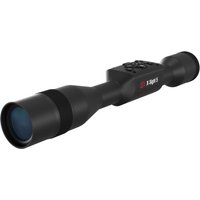
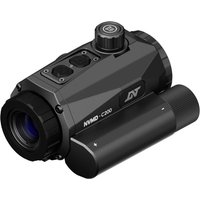
The single most important spec on any thermal scope is sensor resolution, expressed as pixel dimensions like 384×288 or 256×192. Higher resolution means more pixels painting the scene, which translates directly into your ability to distinguish a coyote from a fence post at distance. At the sub-$1000 level, 384×288 is the sweet spot — it gives you a usable image for positive identification out to roughly 200–300 yards depending on conditions. Units with 256×192 sensors can still work for close-range hog hunting inside 150 yards, but you will notice a grainier image and shorter effective ID range. Refresh rate matters too: a 50 Hz display updates smoothly enough for tracking a moving animal, while cheaper 25 Hz units can feel laggy when panning. NETD (Noise Equivalent Temperature Difference) tells you how sensitive the sensor is to small temperature changes — look for 35 mK or lower for cleaner images in cool weather when the contrast between an animal and the ground shrinks.
Budget tiers in the thermal scope world break down clearly. Below $500, you are in spotter or monocular territory — units like entry-level handhelds that are not recoil-rated and should never be mounted on a rifle. The $500–$750 band is where true weapon-grade thermal scopes begin, typically with 256×192 sensors, basic reticle options, and detection ranges around 800–1,200 yards (remember, detection range is not identification range — you may detect heat at 1,000 yards but only positively ID the animal at 250). From $750 to $1,000, you start seeing 384×288 sensors, multiple color palettes, built-in video recording, Wi-Fi streaming, and more refined zero systems. This upper bracket represents the best value for a hunter who wants a primary optic rather than a novelty.
Common mistakes in this category cost hunters real money. First, confusing detection range with identification range: a scope may detect a human-sized heat signature at 1,500 yards, but that same scope might only let you tell a coyote from a dog at 200 yards. Always look at the identification or recognition specification, not the headline detection number. Second, ignoring recoil rating — mounting a non-weapon-rated thermal monocular on a .308 bolt gun will destroy the sensor or crack the housing within a few shots. Third, buying a scope with no zero-adjustment mechanism or with clicks so coarse you cannot hold a usable group. Entry-level thermals sometimes offer only 2 MOA per click, which makes precise zeroing frustrating. Fourth, overlooking battery life: a scope rated for three hours of continuous use will die mid-hunt on a cold January night in the Dakotas, because lithium-ion capacity drops in low temperatures.
For US buyers, the most common thermal-scope platforms are predator and hog rigs. A flat-top AR-15 in .223 Remington or .224 Valkyrie with a Picatinny rail is the most popular host, because recoil is mild enough that even budget thermal scopes survive. Bolt-action rifles in .22-250 or .243 Winchester are also excellent choices for longer-range coyote work. If you are considering a thermal clip-on instead of a dedicated scope — a unit that mounts in front of your existing daytime optic — be aware that quality clip-ons from brands like Pulsar or iRay typically start above $1,500 and add significant weight forward of the action. At the sub-$1000 level, a dedicated thermal scope is almost always the better value. For purchasing, Amazon.com carries many of the leading thermal brands with Prime shipping and straightforward returns, and OpticsPlanet is another reliable US retailer that frequently bundles thermal scopes with mounts or accessories.
Matching a thermal scope to your use case requires honest self-assessment. If you are a weekend coyote caller who hunts open ranch country, prioritize sensor resolution and magnification range — a 384-sensor scope with 2–8× zoom and a good ballistic reticle will serve you well out to 250 yards. If you are a hog hunter working thick East Texas brush at 50–120 yards, a compact 256-sensor unit with a wide field of view and fast target acquisition may be the smarter buy, and you can pocket the savings. For property defense against predators threatening livestock, look for models with picture-in-picture zoom and video recording so you can document depredation events. And if you plan to use the scope across multiple rifles, confirm that the mount system is compatible with standard Picatinny or Weaver-style rails — most thermal scopes ship with a 30 mm or proprietary mount, so verify fitment before ordering.
The brand landscape under $1000 is dominated by a handful of manufacturers. AGM Global Vision, Pulsar (at the top end of the bracket), iRay, and Bering Optics are the names you will encounter most often. Traditional rifle-scope powerhouses like Vortex, Leupold, Nightforce, and Swarovski all make thermal or digital night-vision products, but their thermal weapon sights generally sit well above the $1000 mark — their expertise shines more in premium glass and conventional rifle scopes. Burris and Hawke have explored digital night-vision territory but have not yet released sub-$1000 dedicated thermal scopes. When shopping this bracket, prioritize the thermal-specialist brands and look for solid warranty terms, US-based service centers, and firmware-update support, because thermal technology evolves fast and a manufacturer that pushes updates can materially improve your scope after purchase.