Found an Unknown Scope? How to Identify It & What to Buy Next
By Peter Makulek · Senior Optics Editor · · Live prices from US retailers
You rummage through an estate sale, a grandparent's gun safe, or a pawn shop shelf and find a rifle scope with almost no markings, an impossibly low serial number, and zero search results online. This scenario plays out constantly across forums and social media — someone posts a photo asking "What is this thing?" and the community scrambles to help. The truth is that hundreds of small optics manufacturers existed in the mid-twentieth century, many producing scopes for only a few years before folding, being acquired, or rebranding entirely. Identifying these mystery optics is part detective work, part materials science, and part knowing where to look beyond Google.
The question behind the question is almost always practical: is this old scope worth mounting on a rifle, or should I replace it with something modern? The answer matters because vintage optics — even from respected makers — rarely meet modern standards for optical coatings, reticle precision, or mechanical repeatability. A scope from the 1960s may have uncoated or single-coated lenses, unreliable click adjustments, and no parallax compensation beyond a fixed factory setting. For a rimfire plinker or a wall-hanger, that may be fine. For a deer rifle you trust your tag to, or a precision rig where MOA and MRAD adjustments must track perfectly, a modern replacement is the responsible choice.
This guide serves two purposes. First, we walk you through practical steps for identifying an unknown scope — markings to look for, databases to search, communities to ask, and physical clues that narrow the era and origin. Second, we cover exactly what to look for in a modern replacement scope across every budget tier, whether you need a simple rimfire optic, a serious hunting rifle scope, a first-focal-plane precision model, or even a thermal or night vision scope for predator control. We address the key optical decisions — FFP versus SFP, MOA versus MRAD, parallax adjustment, reticle style — so you can make an informed purchase.
Everything here is written for US shooters. We reference common American calibers and platforms — from .22 LR rimfires and AR-15s in .223/5.56 to bolt guns in .308, 6.5 Creedmoor, and magnum cartridges. Distances reflect real US hunting and shooting scenarios: most whitetail deer are taken inside 150 yards from a stand or blind, while Western mule deer or pronghorn hunts may push past 400 yards. Precision Rifle Series competitors and long-range enthusiasts stretch well beyond that. Your use case determines everything, and we help you match it to the right glass.
Top Picks — Live US Prices
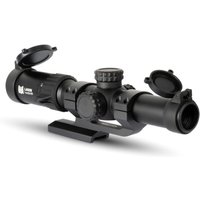
Monstrum Ladon 1-6x24mm LPVO 30mm Tube Rifle Scope, First Focal Plane, CM7 Reticle, Black, FFL16X-CM7
via OpticsPlanet
$134.99
Monstrum Ladon 1-6x24mm LPVO 30mm Tube Rifle Scope, First Focal Plane, CM3 Reticle, Black, FFL16X-CM3
via OpticsPlanet
$134.99
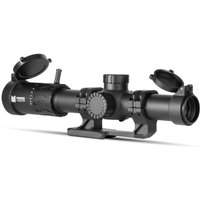
Monstrum Panzer ED 1-6x24mm LPVO 30mm Rifle Scope, First Focal Plane, CM3 Reticle, Black, FFZ16X-B
via OpticsPlanet
$149.99
Buying Advice
Start with the key specifications that separate a competent scope from a poor one. Magnification range should match your shooting: a 3-9x or 4-12x covers most hunting needs inside 300 yards, while a 5-25x or 6-36x suits long-range precision work. Objective lens diameter (the rear number, like 50mm) controls light gathering — larger objectives help at dawn and dusk but add weight and require taller rings. Tube diameter is typically 1 inch or 30mm in the US market; 34mm tubes appear on high-end tactical models. Eye relief of at least 3.5 inches is critical on magnum calibers to avoid scope bite. Check the adjustment range in MOA or MRAD to ensure you have enough elevation travel for your expected drops — a .308 at 1,000 yards needs roughly 35-40 MOA of elevation from a 100-yard zero.
Budget tiers in the US market break down predictably. Entry-level scopes in the $150–$350 range from brands like Vortex (Crossfire and Diamondback lines) and Bushnell (Banner and Engage series) deliver surprisingly good glass for hunting and recreational shooting, typically with SFP reticles, capped turrets, and fixed parallax or side-focus parallax adjustment. Mid-tier optics from $400–$900 — think Vortex Viper PST Gen II, Leupold VX-5HD, Burris Veracity, or Meopta Optika6 — add fully multi-coated lens systems, zero-stop turrets, FFP reticle options, and tighter quality control. Premium glass above $1,000 from Swarovski, Schmidt & Bender, and Leupold's Mark 5HD line offers elite edge-to-edge clarity, bombproof mechanicals, and the kind of optical performance that justifies itself in competition or professional use.
Common mistakes buyers make include over-magnifying for their actual shooting distances, ignoring reticle subtension at different magnifications, and confusing FFP with SFP without understanding the practical difference. In a first-focal-plane scope, the reticle scales with magnification, so holdover marks and windage references are accurate at every power setting — essential for PRS and tactical applications where you change magnification frequently. In a second-focal-plane scope, the reticle stays the same apparent size and is only dimensionally correct at one magnification (usually max). SFP is perfectly fine for most hunters who dial their turrets or shoot at a single magnification. Another frequent error is buying a scope with exposed, locking turrets for a hunting rifle that will ride in a scabbard or truck rack — capped turrets prevent accidental zero shifts in the field.
For US-specific context, consider what you are actually doing. A whitetail hunter in the hardwoods of Pennsylvania or the piney bottoms of Alabama rarely needs more than a 3-9x40 with a simple duplex reticle — and an SFP model is ideal because shots are close and fast. A Western hunter glassing basins in Wyoming or Colorado benefits from a 4-16x or 5-25x with a BDC or Christmas-tree reticle calibrated to their specific cartridge. Predator and hog hunters working at night increasingly turn to thermal scopes from Pulsar or dedicated night vision scope units that clip on ahead of a day optic. For rimfire and air rifle shooters, stick to scopes rated for springer recoil if applicable and remember that sub-12 ft-lb air rifles are realistically effective only to about 50–75 yards — a 3-9x or 4-12x with an AO parallax knob set to 25–50 yards is ideal. Buy from Amazon.com for convenience and easy returns, or from OpticsPlanet for a wider selection and frequent coupon codes.
Matching the scope to your use case is the single most important step. Ask yourself three questions: What is my maximum realistic engagement distance? Will I dial turrets or hold over using my reticle? And what is the harshest condition I will face — rain, snow, extreme cold, heavy recoil? Long-range shooters who dial should prioritize a tall turret with a reliable zero-stop mechanism, an FFP MRAD reticle (where 0.1 mil equals 1 cm at 100 meters, making metric range cards intuitive), and a side-focus parallax knob. Hunters who hold and shoot quickly benefit from an illuminated SFP reticle, generous eye relief, a lightweight build, and a wide field of view at low magnification. Spotting scopes in the 15-45x60 or 20-60x80 class from Vortex (Diamondback HD, Razor HD) or Meopta serve double duty for glassing game and calling shots at the range.
The brand landscape in 2026 is remarkably competitive. Vortex dominates the value conversation with an unconditional lifetime warranty and models spanning every price point. Leupold remains the gold standard for lightweight American-made hunting scopes. Burris offers innovative features like the Eliminator rangefinding reticle at aggressive price points. Meopta provides European-grade glass at mid-tier American prices. At the top end, Swarovski and Schmidt & Bender deliver optical performance that competition shooters and professional marksmen rely on worldwide. For thermal and night vision, Pulsar leads in the consumer-accessible thermal scope market, with models that range from entry-level units under $2,000 to flagship thermals pushing past $5,000. Whichever brand you choose, buy from an authorized dealer to ensure your warranty is honored — the AIScopes dealer locator covers all 50 states.
Frequently Asked Questions
How do I identify an old rifle scope with no visible brand markings?
Start by examining every surface under strong light for stampings, etchings, or patent numbers — many vintage scopes have markings hidden under the eyepiece ring or on the saddle. Check the serial number format and Google it alongside terms like "vintage rifle scope" or "scope patent." Post clear photos to communities like Reddit's r/guns, the Rimfire Central optics forum, or the Vintage Sniper Rifle forum. Physical clues like tube diameter (3/4 inch was common pre-1960), lens coating color, and turret style help narrow the era and manufacturer.
Is it safe to use a vintage scope on a modern hunting rifle?
It depends on the scope's mechanical condition and the rifle's recoil. A vintage scope on a mild-recoiling .22 LR rimfire or a .243 bolt gun is generally fine if the lenses are clear and the adjustments hold zero. On a hard-kicking magnum like a .300 Win Mag, old adhesives, brittle seals, and worn erector springs can fail catastrophically. If the scope fogs internally or clicks do not track consistently when you box-test it, replace it with a modern optic rated for your caliber's recoil.
What is the difference between FFP and SFP, and which should I choose?
In a first-focal-plane (FFP) scope, the reticle enlarges and shrinks with the magnification, so subtension values — holdover dots, windage marks — are accurate at every power setting. In a second-focal-plane (SFP) scope, the reticle size stays constant and is only dimensionally correct at one magnification, usually the highest. FFP is preferred for precision and tactical shooting where magnification changes frequently. SFP is excellent for hunters who shoot at a set magnification and prefer a cleaner, thinner reticle at lower power.
Should I choose MOA or MRAD for my scope reticle and turrets?
Both systems work equally well — the key is consistency between your reticle and turret adjustments. MOA (minute of angle) clicks are typically 1/4 MOA, with 1 MOA equaling approximately 1.047 inches at 100 yards, which many American shooters find intuitive. MRAD (milliradian) clicks are typically 0.1 mil, with 0.1 mil equaling 1 cm at 100 meters, making metric-based ballistic calculators very straightforward. PRS competitors and military-trained shooters tend to favor MRAD; traditional hunters often prefer MOA. Neither is objectively better.
What does parallax adjustment do, and do I need it?
Parallax error occurs when the target image and the reticle are not on the same focal plane, causing the point of aim to shift as you move your eye behind the scope. A parallax adjustment knob (usually on the left side of the turret housing, or as an adjustable objective ring on the front bell) lets you focus the target image onto the reticle plane at varying distances. For rimfire and close-range hunting scopes, a fixed parallax setting of 50–100 yards is usually sufficient. For precision shooting beyond 200 yards, a side-focus parallax knob is essential.
What scope magnification do I actually need for whitetail deer hunting?
Most whitetail deer in the eastern US are taken inside 150 yards from a treestand or ground blind, and a 3-9x40 or 2-10x42 scope is more than adequate. Higher magnification narrows your field of view and makes target acquisition slower — both liabilities on a moving deer in timber. For open-country hunting in the Midwest or West where shots may reach 300–400 yards, a 4-16x44 or 5-25x50 provides the extra reach without being unwieldy. Resist the urge to buy more magnification than your realistic shooting distances demand.
Are thermal scopes legal for hunting in the US?
Thermal and night vision scope legality varies by state and by game species. Many states permit thermal optics for predator and hog hunting — Texas, for example, allows thermal for feral hogs and coyotes with no restrictions. However, some states prohibit electronic sighting devices for big game like deer or elk. Always check your specific state's fish and wildlife regulations before purchasing. Pulsar is the market leader in consumer thermal scopes, with models available on Amazon.com and through specialty retailers like OpticsPlanet.
Can I put a centerfire rifle scope on a spring-piston air rifle?
Not always. Spring-piston (springer) air rifles produce a unique double-recoil impulse that can destroy scopes not rated for it. Many centerfire scopes are designed to handle rearward recoil only, while springers jolt forward and then backward. Look for scopes explicitly rated for spring-piston or airgun use, or choose brands like Vortex that cover airgun damage under warranty. Remember that sub-12 ft-lb springers are realistically effective only to about 50–75 yards, so a 3-9x or 4-12x with a parallax adjustment set as low as 10 yards is ideal.
Where is the best place to buy rifle scopes in the US?
Amazon.com offers fast shipping, easy returns, and competitive pricing on most major brands — look for listings sold by authorized dealers to protect your warranty. OpticsPlanet carries an enormous selection including hard-to-find models and frequently offers coupon codes or mil/LEO discounts. Local gun shops and sporting goods stores let you handle scopes before buying and often provide mounting services. Use the AIScopes dealer locator at aiscopes.co.uk to find authorized retailers in all 50 states.
Related guides
Learn how to identify counterfeit rifle scopes, thermal optics, and night vision devices sold on eBay.
Match the Right Scope to Your Rifle in 2026Stop wasting money on mismatched optics. Our 2026 guide helps US shooters pair the right rifle scope to every platform—from rimfire and air rifle…
Tall-Target, Box Test & Return-to-Zero: Test Your Scope RightLearn how to test any rifle scope yourself with the tall-target test, box test, and return-to-zero check.
MPVO vs LPVO: Which Variable Scope Belongs on Your AR-15 or Hunting Rifle?MPVO scopes (2-10x, 2-12x, 3-15x) bridge the gap between LPVO and high-power glass. Learn which magnification range fits your AR-15 or hunting rifle…
Steiner T6Xi Magnification: Which Power Range Do You Need?Confused by Steiner T6Xi magnification options? Our 2026 guide breaks down every power range — 1-6x, 2.5-15x, 3-18x, 5-30x…
Best Scopes for .22-250 Remington in 2026Find the best scopes for .22-250 Remington in 2026. We cover magnification, reticle subtension, fast-twist barrel considerations…
Locking Elevation Turrets ExplainedDiscover proven solutions for locking your rifle scope elevation turret in 2026. We compare CRS, cap-lock, and zero-stop systems across top US brands…
Not sure which scope is right for you?
Try our AI-powered scope finder — answer a few questions and get personalised recommendations.
Find My Scope →Get a scope tip every day
Follow AiScopes on Facebook for daily buying guides, deals and gear advice.
Follow on Facebook