7mm Rem Mag Scope Problems — Fixes & Best Optics for 2026
By Peter Makulek · Senior Optics Editor · · Live prices from US retailers
Quick answer: most 7mm Rem Mag scope failures come down to three things — a scope that cannot handle the 20–25 ft-lbs of recoil the cartridge generates, improper ring torque or mounting, or parallax set at 100 yards when you are shooting at 400+. A proven fix is to step up to a scope built for magnum recoil with a 30mm or 34mm tube — models like the Vortex Viper PST Gen II or Leupold VX-6HD survive thousands of rounds without tracking issues.
The 7mm Remington Magnum is one of the most popular long-range hunting cartridges in the US for good reason. Pushing a 162-grain ELD-X at roughly 2,940 ft/s from a 26-inch barrel, it delivers flat trajectories and devastating terminal performance on elk, mule deer, and even moose at distances well past 400 yards. But that performance comes at a cost to optics. The cartridge's sharp, rearward recoil impulse is notorious for destroying lesser scopes — internal erector springs fatigue, reticles cant, turrets lose zero, and lenses crack. Forums are full of shooters who mounted a bargain scope on their Remington 700 or Browning X-Bolt and watched the point of impact wander after 50 rounds.
The real challenge is that 7mm Rem Mag shooters often need more from their optics than the average deer hunter. You are typically shooting across western canyons, open sage flats, or alpine bowls at distances from 200 to 600 yards. That demands higher magnification, reliable tracking, usable turrets, and parallax adjustment — features that push you into mid-tier and premium price brackets where quality control genuinely matters. A rimfire scope or a basic duplex hunting scope designed for a .243 simply will not survive, and it certainly will not give you the tools to make ethical shots on elk at 450 yards in variable wind.
This guide walks through every common 7mm Rem Mag scope issue US shooters report — from reticle shift to fogged internals — explains how to prevent or fix each one, then recommends scopes at multiple budget tiers that are proven to handle magnum recoil. We also cover the mounting system (rings, bases, and torque specs), parallax adjustment, FFP versus SFP considerations, and the MOA-vs-MRAD decision for western hunting. Whether you are building a dedicated elk rig or troubleshooting a scope that just lost zero on your last range trip, this is the page to bookmark.
Top Picks — Live US Prices
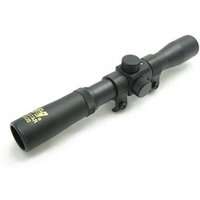
NcSTAR Compact 4x20 Air Gun Rifle Scope, Black, Duplex Reticle - SCA420B
via OpticsPlanet
$12.99

Barska 4X20 Rimfire Rifle Scope, Black Matte AC10730
via OpticsPlanet
$18.99

Daisy Powerline Airgun Scope, 4x15, Crosshair Reticle, Black, 980808-444
via OpticsPlanet
$20.99
Buying Advice
Start with the specs that actually matter for magnum-recoil survival. Tube diameter is your first filter: 30mm tubes offer more internal adjustment range and generally use thicker aluminum, making them more robust than 1-inch tubes under repeated magnum punishment. Premium 34mm tubes from Nightforce or Schmidt & Bender add even more strength, but they also add weight and cost. Next, check the rated recoil resistance — manufacturers like Vortex and Leupold explicitly test to specific G-force thresholds, and any scope rated for .375 H&H or above will handle 7mm Rem Mag comfortably. Objective lens diameter of 50mm is a common sweet spot: it gathers enough light for dawn and dusk shots without making the scope so heavy that it upsets your rifle's balance. Finally, verify that the scope has side-focus parallax adjustment — a fixed 100-yard parallax scope introduces noticeable aiming error at 300+ yards, which is exactly where you need the 7mm Rem Mag's ballistic advantage.
Budget tiers for 7mm Rem Mag scopes break into three practical bands. In the entry tier (roughly $250–$450), you will find scopes like the Bushnell Banner 2 or Vortex Diamondback Tactical with SFP reticles, basic turrets, and adequate glass — they work, but turret tracking may drift after several hundred rounds of magnum recoil, and the coatings are not premium. The mid tier ($500–$1,000) is where most serious elk hunters land: the Vortex Viper PST Gen II, Leupold VX-5HD, and Burris Veracity lines deliver repeatable tracking, HD glass, zero-stop turrets, and lifetime warranties. The premium tier ($1,200–$3,000+) includes Nightforce NX8 and ATACR, Schmidt & Bender PMII, and Leupold Mark 5HD — these are virtually bomb-proof, with match-grade tracking, exceptional edge-to-edge clarity, and illuminated reticles that actually help in low light. For most US hunters, the mid tier is the rational investment.
The most common mistakes buyers make with 7mm Rem Mag setups involve mounting, not the scope itself. First, using aluminum rings on a magnum rifle is asking for scope slip — steel or quality two-piece bases with Torx-head ring screws are far more secure. Torque your ring screws to the manufacturer's spec (usually 15–25 inch-pounds) with a proper torque wrench; guessing leads to either stripped screws or a scope that walks forward under recoil. Second, many shooters set up a brand-new scope and never perform a box test or tall-target test to verify tracking before heading afield — this is how you discover an internal defect before it costs you an elk tag. Third, some hunters buy the highest magnification they can find (say 6-24x) and then never use it below 12x; for western hunting, a 4-16x or 5-25x range with quality glass almost always outperforms a cheap 6-24x because you get a wider field of view at lower powers for close encounters in timber.
US-specific context matters for this cartridge. The 7mm Rem Mag is a staple in western states — Montana, Wyoming, Colorado, Idaho, and New Mexico — where shots across open terrain routinely exceed 300 yards. If you are hunting eastern whitetail from a treestand at 80 yards, you frankly do not need a magnum or an expensive long-range scope; a good 3-9x40 on a .308 or .30-06 does the job. But for elk in the Rockies or mule deer on BLM land, the 7mm Rem Mag paired with a quality 4-16x or 5-25x scope is the gold standard. Purchasing is straightforward: Amazon.com carries most Vortex, Leupold, and Bushnell models with solid return policies, and OpticsPlanet often has a wider selection of Nightforce and S&B. Use our dealer locator at aiscopes.us if you prefer to mount and bore-sight locally.
Matching the scope to your specific use case is the final step. For a dedicated elk rifle you will carry on horseback or backpack hunts, keep total scope weight under 24 ounces — the Leupold VX-5HD 3-15x44 or Vortex Razor HD LHT 4.5-22x50 are standout choices. For a range-and-hunt crossover where you also shoot steel to 1,000 yards, step into an FFP scope with an MRAD Christmas-tree reticle like the Nightforce NX8 4-32x50 or Vortex Viper PST Gen II 5-25x50 — FFP means your holdovers and wind calls stay accurate at every magnification, which matters when you dial up fast in the field. If your primary concern is low-light performance for timber hunts at dawn and dusk, prioritize a large objective (50–56mm), fully multi-coated lenses, and an illuminated center dot. For thermal scouting paired with a day scope, Pulsar and Hikmicro make clip-on or stand-alone thermal units that can mount in front of your optic or serve as a spotting scope — increasingly popular for predator hunting in states like Texas and Oklahoma.
A brief brand landscape for 2026: Vortex remains the best overall value proposition for US magnum-rifle hunters thanks to their unconditional lifetime VIP warranty — if your scope breaks for any reason, they replace it. Leupold is made in Oregon and has the strongest legacy in US hunting optics; their Custom Dial System (CDS) turrets let you engrave a custom BDC dial matched to your exact 7mm Rem Mag load. Nightforce is the go-to for shooters who want match-grade tracking and indestructible construction but are willing to pay a premium. Burris offers excellent mid-range options with their Forever Warranty. Schmidt & Bender sits at the absolute top for European-engineered glass quality. Bushnell provides solid entry-level and mid-tier options, especially the Engage and Match Pro lines. In the thermal and night-vision space, Pulsar and Hikmicro lead the US aftermarket for both clip-on and handheld thermal units that complement a traditional rifle scope.
Frequently Asked Questions
What is the best scope for elk hunting with a 7mm Rem Mag?
For most US elk hunters, the Vortex Viper PST Gen II 5-25x50 FFP or the Leupold VX-5HD 3-15x44 CDS-ZL2 are the top recommendations in 2026. The Vortex gives you FFP precision with an MRAD reticle and zero-stop turrets for longer shots across open terrain, while the Leupold is lighter and features a custom ballistic dial that makes field adjustments faster. Both are proven to handle thousands of rounds of magnum recoil, and both fall in the $800–$1,200 range — the sweet spot for serious western-game optics.
What is the best scope for elk hunting with a 300 Win Mag?
The .300 Win Mag generates very similar recoil to the 7mm Rem Mag (roughly 25–30 ft-lbs in a typical rifle), so the same scopes apply. The Leupold VX-6HD 3-18x50, Nightforce NX8 4-32x50, and Vortex Razor HD LHT 4.5-22x50 are all excellent choices. Prioritize a 30mm or 34mm tube, side-focus parallax, and at least 15x top-end magnification for shots past 400 yards. The scope mounting system matters just as much — use quality steel rings torqued to spec.
Why does my scope keep losing zero on my 7mm Rem Mag?
The three most common causes are ring or base failure, internal erector-tube fatigue, and scope-body flex from a tube that is too thin. First, verify your rings are torqued to spec (typically 15–25 inch-pounds) on a quality Picatinny or Redfield-style base with no stripped screws. Second, check whether the scope is rated for magnum recoil — many budget scopes under $200 simply are not, and their internal springs or detent mechanisms fail after repeated firing. If you have confirmed the mount is solid, perform a box test: dial 10 MOA up, 10 right, 10 down, 10 left, and see if you return to your original zero — if not, the scope's internals are damaged.
Do I need an FFP or SFP scope for a 7mm Rem Mag hunting rifle?
It depends on how you use the reticle. If you dial your turret for every shot (most traditional hunters do), an SFP scope is perfectly fine and often offers a cleaner reticle at low magnification. If you hold over or hold off for wind using the reticle's subtension marks — common in fast-paced western hunting where you might not have time to dial — then an FFP scope is essential because the holdover values stay correct at any magnification. FFP scopes tend to cost $100–$300 more at equivalent quality levels.
What scope magnification do I need for 7mm Rem Mag?
A 4-16x or 5-25x variable is the practical sweet spot for most 7mm Rem Mag applications. The lower end (4x–5x) gives you a wide field of view for shots in timber or at close range, while 16x–25x provides enough detail to place shots precisely at 500–700 yards. Avoid going below 3x on the low end if you also plan to use the rifle for longer-range target work, and avoid scopes topping out at 9x or 10x — you are leaving the cartridge's long-range potential on the table.
What are scope rings, and which ones should I use for a magnum rifle?
Scope rings are the clamps that secure the scope tube to a base or rail mounted on your rifle's receiver. For magnum cartridges like the 7mm Rem Mag, use steel or high-grade aluminum rings from brands like Vortex, Leupold, or Nightforce — avoid lightweight alloy rings marketed for rimfire or air rifle use. Match the ring diameter to your scope tube (30mm or 34mm), choose the correct height so the objective bell clears the barrel, and always torque screws with an inch-pound wrench to the manufacturer's specification.
Should I choose MOA or MRAD for a 7mm Rem Mag hunting scope?
Either system works perfectly well for hunting. MOA (minute of angle) adjustments are more intuitive for US shooters who think in inches — 1 MOA equals approximately 1.047 inches at 100 yards. MRAD (milliradian) adjustments use a metric-friendly scale where 0.1 mil equals 1 cm at 100 meters, and each click moves the point of impact in 0.36-inch increments at 100 yards. MRAD math is simpler for rapid corrections at long range, which is why competitive and tactical shooters favor it. Choose whichever system you are willing to practice with consistently.
Can I use a thermal scope on my 7mm Rem Mag?
Yes, but most stand-alone thermal rifle scopes (like those from Pulsar or Hikmicro) are designed for moderate-recoil cartridges and may not be rated for sustained magnum use — always check the manufacturer's recoil rating. A popular alternative is a clip-on thermal device that mounts in front of your existing day scope, letting you detect heat signatures without subjecting the thermal unit to direct recoil stress. Thermal optics are increasingly popular for predator hunting in states like Texas but are prohibited for big-game hunting in some western states, so verify your local regulations.
Need help identifying a scope part — what is the knob on the left side?
If it is on the left side of the scope body (opposite the windage turret), it is almost certainly the side-focus parallax adjustment knob. Turning it changes the focal distance of the internal optics to eliminate parallax error at your target's range — typically adjustable from about 10 or 15 yards out to infinity. Some older or budget scopes place parallax adjustment on the objective bell (AO, or adjustable objective) at the front of the scope instead. The top turret adjusts elevation, the right-side turret adjusts windage, and a small dial on the elevation turret housing may be an illumination control for a lighted reticle.
Related guides
Mk Machining scope cap warranty issues explained. Learn how to file claims, find alternatives, and protect your rifle scope investment in 2026.
New Hunter? How to Pick Between Two ScopesFirst-time hunter torn between two rifle scopes? Our 2026 guide breaks down magnification, reticle type, glass quality…
Not sure which scope is right for you?
Try our AI-powered scope finder — answer a few questions and get personalised recommendations.
Find My Scope →Get a scope tip every day
Follow AiScopes on Facebook for daily buying guides, deals and gear advice.
Follow on Facebook