Best Optics for Shooting Beyond 800 Yards
By Peter Makulek · Senior Optics Editor · · Live prices from US retailers
Consistently hitting steel or taking ethical shots on game beyond 800 yards demands optics that perform at a level most general-purpose scopes simply cannot reach. At that distance a 6.5 Creedmoor round drops roughly 15–17 MOA depending on load and conditions, and a 10 mph full-value crosswind can push it more than 4 MOA off center. Your glass needs to let you see mirage, read wind, dial precise corrections, and confirm hits — all without optical compromise. Whether you are building a PRS competition rig, setting up a dedicated long-range hunting rifle in .300 PRC, or assembling a precision .308 Win trainer, the optic you bolt on top is the single component that turns capability into repeatable results.
This guide is written specifically for US shooters who are serious about 800-yard-plus performance. We cover dedicated rifle scopes — both first focal plane and second focal plane — along with thermal scopes for predator and hog work at extended range, night-vision clip-on devices, and high-power spotting scopes for calling shots or scanning western-US terrain. We also address the Vortex and Leupold lineups that dominate the American market, along with premium European and Japanese options from Nightforce, March, Zeiss, and Swarovski that many PRS and F-class competitors trust.
Choosing the right optic for this mission is not just about magnification. Reticle plane (FFP vs. SFP), adjustment system (MOA vs. MRAD), parallax control, tracking accuracy, turret repeatability, and glass quality all matter enormously once you push past 600 yards. A turret that drifts half a mil after five revolutions can mean a two-foot miss at 1,000 yards. A reticle with poorly calibrated subtensions can invalidate every wind hold you attempt. We dig into each of these factors so you can make an informed decision rather than an expensive guess.
Budget is always part of the conversation, and the good news for American shooters in 2026 is that the competitive landscape has pushed quality downward in price. You can find genuinely capable long-range glass starting around the $500–$700 tier, with mid-range options in the $1,000–$2,000 bracket that would have embarrassed flagship scopes from a decade ago. Premium competition and tactical scopes from Nightforce, March, and Zeiss occupy the $2,500–$4,000+ space, offering the tightest tolerances and the best glass coatings available. We break all of this down below, after our curated product picks.
Top Picks — Live US Prices
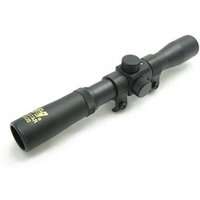
NcSTAR Compact 4x20 Air Gun Rifle Scope, Black, Duplex Reticle - SCA420B
via OpticsPlanet
$12.99

Barska 4X20 Rimfire Rifle Scope, Black Matte AC10730
via OpticsPlanet
$18.99

Daisy Powerline Airgun Scope, 4x15, Crosshair Reticle, Black, 980808-444
via OpticsPlanet
$20.99
Buying Advice
Start with the specs that actually govern performance beyond 800 yards. Total elevation travel determines how far you can dial before running out of adjustment; for a 6.5 Creedmoor zeroed at 100 yards and engaging at 1,200 yards, you may need 30+ MOA (roughly 9 MRAD) of up-travel. A scope with only 50 MOA total and a rail with no cant may not get you there. Look for at least 80–100 MOA total travel, or pair a standard scope with a 20-MOA canted base. Parallax adjustment is critical too — at 800 yards, a scope with a fixed 100-yard parallax setting introduces enough apparent reticle shift to cost you easy misses. Side-focus parallax that adjusts from 50 yards to infinity is the baseline standard for serious long-range glass.
Understanding reticle plane is essential. A first-focal-plane (FFP) reticle scales with magnification, meaning the subtensions in your Christmas-tree or Horus-style reticle are always accurate for wind holds and range estimation regardless of your zoom setting. This is why FFP dominates PRS competition and tactical applications. A second-focal-plane (SFP) reticle only reads true at one magnification — typically the highest — which can work well for hunting where you dial your correction and shoot at max power, but introduces a serious error risk if you hold off at a lower zoom setting. For 800+ yards, FFP is the safer and more versatile choice for most shooters.
Budget tiers in 2026 break down clearly. Entry-level long-range scopes in the $500–$800 range — think Vortex Diamondback Tactical, Bushnell Match Pro, or the budget end of the Primary Arms GLx line — deliver usable FFP reticles, exposed turrets, and side parallax, but may compromise on glass clarity at high magnification and turret repeatability over many rotations. Mid-tier scopes from $1,000 to $2,000 — such as the Vortex Viper PST Gen II, Leupold Mark 5HD, or Bushnell XRS3 — offer dramatically better optical quality, tighter tracking tolerances, and more refined turret feel. Premium scopes above $2,500 from Nightforce (ATACR), March (High Master), and Zeiss (LRP S5) push the boundaries of resolution, color fidelity, and mechanical precision for competitors and professional marksmen.
Common mistakes cost shooters money and frustration. One of the biggest is buying too much magnification and not enough objective lens quality — a cheap 6-24×50 at 24× will show you a dim, hazy image at 800 yards in low light, while a premium 5-25×56 will resolve bullet trace through mirage. Another error is ignoring turret repeatability: some budget scopes track well for one revolution but wander on the return, which means your zero shifts after every range session. Always verify tracking with a tall-target test before trusting a new scope in the field. Finally, many hunters overbuy — if your longest realistic shot on pronghorn across Wyoming sage flats is 600 yards, a mid-tier 4-16× or 5-25× is more than sufficient. Reserve the heavy, high-magnification competition glass for bench or prone shooting disciplines.
For US shooters, the buying landscape is straightforward. Amazon.com carries a broad selection from Vortex, Bushnell, Leupold, and Pulsar, often with Prime shipping and competitive pricing. OpticsPlanet is a strong second option with deeper inventory in niche brands like March and Kahles, plus occasional financing options on premium glass. When buying thermal scopes or night-vision devices, be aware that some models — particularly Gen 3 image-intensified tubes — are export-controlled under ITAR but are perfectly legal for US civilians to purchase and own. Pulsar leads the consumer thermal market with models like the Thermion 2 LRF series that combine thermal imaging with built-in laser rangefinders, making 800-yard shots on hogs or coyotes at night a realistic proposition. For spotting scopes used to call shots during long-range sessions, Vortex Razor HD, Leupold SX-5 Santiam, and Swarovski ATX/STX modular systems are the standards on US firing lines.
Match the optic to your actual use case. A PRS competitor shooting positional stages at unknown distances needs an FFP MRAD scope with a detailed hold-over reticle, a zero stop, and fast-focus eyepiece — optical models like the Nightforce ATACR 7-35×56 or Vortex Razor HD Gen III 6-36×56 are purpose-built for this. A western big-game hunter reaching out on mule deer or elk across a canyon at 600–900 yards benefits from a lighter, more compact scope with excellent dawn/dusk performance — the Leupold VX-6HD 4-24×52 or Zeiss V6 5-30×56 fit well. A dedicated benchrest or F-class shooter may prefer a high-magnification SFP scope with fine crosshair for group shooting. And a predator hunter working hogs at night past 800 yards should seriously evaluate thermal optics from Pulsar or clip-on night-vision units that mount ahead of a conventional day scope. There is no single best optic — there is only the best optic for your mission, your rifle, and your budget.
Frequently Asked Questions
Is FFP or SFP better for shooting beyond 800 yards?
For most shooters engaging targets past 800 yards, a first-focal-plane (FFP) scope is the better choice. The reticle subtensions remain accurate at every magnification, so wind holds and range estimations work whether you are at 10× or 25×. SFP scopes can work if you always dial corrections at max power, but the risk of using incorrect holdovers at partial zoom makes FFP safer and more versatile for extreme-range work.
Should I choose MOA or MRAD for long-range shooting?
Both systems are mathematically valid and equally precise. MRAD (milliradians) has become the dominant standard in PRS competition, military use, and most modern long-range scopes because the math is base-10: 0.1 MRAD equals 1 centimeter at 100 meters, or roughly 0.36 inches at 100 yards. MOA is more intuitive for shooters who think in inches — 1 MOA is approximately 1.047 inches at 100 yards. Choose whichever matches your training, your ballistic solver output, and the reticle subtensions on your preferred scope.
How much magnification do I need for 800-yard shots?
A scope with a top end of 20× to 25× is sufficient for most 800-yard applications on steel or medium game. Many PRS shooters compete effectively at 15×–20× to maintain a wider field of view and better mirage reading. Scopes in the 5-25×56 or 6-36×56 class offer a versatile zoom range that covers everything from 100-yard zeroing to 1,200-yard engagements without being excessively heavy.
Can a thermal scope be effective at 800+ yards?
Yes, modern thermal rifle scopes from brands like Pulsar have detection ranges well beyond 800 yards and identification ranges that continue to improve with each sensor generation. Models with higher-resolution 640×480 sensors and integrated laser rangefinders allow ethical shots on hogs and coyotes at extended range during nighttime hunts. However, thermal scopes generally offer lower optical magnification than conventional day scopes, so confirming precise shot placement at extreme distance requires a quality unit with good pixel density on target.
What is a zero stop and why does it matter for long-range shooting?
A zero stop is a mechanical hard stop set at your 100-yard (or other baseline) zero that prevents the turret from dialing below that point. After dialing up 8 or 10 MRAD for a long shot, you can spin the turret back down rapidly until it hits the stop and know you are precisely back at zero. Without one, it is easy to lose track of revolutions and end up shooting with several MRAD of unintended offset — a catastrophic error at 800+ yards.
What are the best Vortex scopes for 800+ yard shooting?
The Vortex Razor HD Gen III 6-36×56 is widely considered one of the top competition long-range scopes available, offering outstanding glass quality, precise tracking, and an excellent EBR-7C MRAD reticle. The Viper PST Gen II 5-25×50 occupies the mid-tier and is one of the best values in long-range optics, delivering FFP MRAD performance at a price point most serious shooters can reach. The Diamondback Tactical 6-24×50 FFP is a capable budget entry for shooters building their first precision rig.
What Leupold scopes work well for long-range shooting past 800 yards?
The Leupold Mark 5HD line is purpose-built for long-range precision. The 5-25×56 and 7-35×56 variants offer excellent glass clarity, reliable tracking, and Leupold's robust build quality backed by their lifetime guarantee. For hunters who want lighter weight without sacrificing long-range capability, the VX-6HD 4-24×52 provides a versatile zoom range with outstanding low-light performance. Leupold scopes are assembled in Beaverton, Oregon, which appeals to US shooters who prioritize American-made products.
Do I need a 20-MOA canted scope base for 800-yard shooting?
It depends on your cartridge and your scope's total elevation travel. A flat-shooting cartridge like 6.5 PRC may only need 20–22 MOA of up-travel to reach 800 yards, which most modern scopes handle without a canted base. But if you plan to stretch to 1,000–1,200+ yards or shoot a cartridge with more drop like .308 Winchester, a 20-MOA base reclaims elevation travel by biasing your adjustment range upward. It is inexpensive insurance and has essentially no downside for a dedicated long-range setup.
Can night vision be used effectively at 800 yards?
Dedicated clip-on night-vision devices mounted ahead of a conventional day scope can extend your capability into darkness while retaining your scope's full magnification and reticle. High-quality Gen 3 image-intensified units offer the resolution needed for target identification at extended range under starlight or moonlight conditions. However, effective night-vision shooting at 800 yards requires excellent ambient light conditions or supplemental IR illumination, plus a rifle and load combination with known ballistic data. For most nighttime predator and hog hunters, thermal scopes provide a more practical all-conditions solution.
Related guides
Find the best optic for your 10.5"–12.5" AR pistol or SBR. We compare LPVOs, prism sights, and red dots across weight, eye relief…
Identifying Night Owl Optics Monoculars & Choosing a Worthy SuccessorStruggling to identify a Night Owl Optics monocular? Our 2026 guide covers model identification, specs to look…
Barrett MRAD Barrel Swaps: Optics That Hold Zero Every TimeSwapping barrels on your Barrett MRAD? Our 2026 guide covers the best scopes, mounts, and zero-retention strategies so you stay on target across every…
Best Scopes for Sub-Inch Targets at 40–50 Yards With a .22 Spring RifleNew to spring-piston air rifles? Learn exactly which scope magnification, reticle, and parallax settings let you hit sub-inch targets at 40–50 yards…
Not sure which scope is right for you?
Try our AI-powered scope finder — answer a few questions and get personalised recommendations.
Find My Scope →Get a scope tip every day
Follow AiScopes on Facebook for daily buying guides, deals and gear advice.
Follow on Facebook