LPVO Mount Heights, Cantilever Offset & Piggyback Dots
By Peter Makulek · Senior Optics Editor · · Live prices from US retailers
Quick answer: for most AR-15 shooters running an LPVO, a 1.70" mount height offers the best balance of comfortable cheek weld, passive aiming with night-vision devices, and room for a piggyback micro red dot. If you shoot heads-up only without night vision and want a traditional stock weld, 1.54" (lower 1/3 co-witness) works great; if you run dedicated night vision or prefer a fully heads-up posture, step up to 1.93" or even 2.26".
Mount height is one of the most overlooked decisions when setting up a low-power variable optic, yet it fundamentally shapes how quickly you acquire targets, how repeatable your natural point of aim becomes, and whether accessories like piggyback dots or clip-on night-vision devices will physically clear the housing. The four standard centerline heights — 1.54", 1.70", 1.93", and 2.26" above the top of the Picatinny rail — each correspond to a specific shooting posture and accessory stack. Understanding why these numbers exist, rather than just copying someone else's setup, prevents expensive trial-and-error.
Cantilever offset matters just as much as height. A cantilever mount shifts the scope's rear ring forward of the upper receiver, placing the optic's eyepiece closer to your eye without moving the entire scope onto the handguard. This is critical for LPVOs because they tend to have shorter eye relief (typically 3.5"–4.0") than traditional riflescopes, and mounting the tube too far forward or rearward creates a tunneled or shadowed image. Most quality cantilever mounts provide 2"–3" of forward offset, which keeps the full tube on the monolithic upper receiver for maximum rigidity while positioning the eyepiece where your eye naturally lands on an AR-platform rifle with a standard or slightly extended buttstock.
The US market has driven most of the innovation here because the AR-15 is America's most popular rifle platform and LPVO adoption has exploded across disciplines — from 3-Gun competition to hog hunting to home defense. Brands like Vortex, Nightforce, Leupold, and Badger Ordnance offer mounts at every height tier, and the trend toward taller mounts parallels the growth of night-vision-equipped shooting and the heads-up, both-eyes-open aiming style borrowed from competition. Whether you are running a Vortex Razor Gen III 1-10x24 or a Leupold Mark 5HD 1-5x24, picking the right mount height and offset is what turns a good optic into a properly integrated weapon system.
Top Picks — Live US Prices
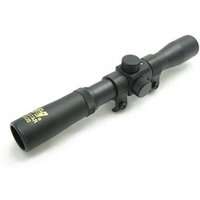
NcSTAR Compact 4x20 Air Gun Rifle Scope, Black, Duplex Reticle - SCA420B
via OpticsPlanet
$12.99

Barska 4X20 Rimfire Rifle Scope, Black Matte AC10730
via OpticsPlanet
$18.99

Daisy Powerline Airgun Scope, 4x15, Crosshair Reticle, Black, 980808-444
via OpticsPlanet
$20.99
Buying Advice
Start by understanding what each number actually measures. The height figure — 1.54", 1.70", 1.93", or 2.26" — is the distance from the top surface of a standard MIL-STD-1913 Picatinny rail to the optical centerline of the scope when mounted. On a flat-top AR-15 upper, the rail sits roughly 2.6" above the bore centerline, so a 1.54" mount puts the scope's optical center about 4.14" above the bore. That geometric relationship determines the mechanical offset at close range (the difference between where the reticle points and where the bullet impacts inside 25 yards), how much you tilt your head to see through the eyepiece, and whether the scope's objective bell clears the top rail or any front sight base. Cantilever offset, measured as the horizontal distance from the mount's clamping footprint to the center of the scope rings, typically ranges from 0" (in-line) to about 3" forward. More offset means the eyepiece sits farther rearward toward your shooting eye without the rear ring hanging off the receiver onto the handguard, which could introduce flex. Check the mount's specification sheet for both the centerline height and the offset dimension before purchasing.
Budget tiers in the US market break down clearly. Entry-level mounts in the $40–$100 range — such as offerings from Aero Precision, Primary Arms, and some Vortex models — are typically aluminum with steel crossbolts and work fine for recreational range use. Mid-tier mounts from $100–$250 include options from Vortex (the Sport cantilever line), Leupold (Mark AR), and Athlon's house-brand selections; they feature tighter machining tolerances, better anodizing, and often include a return-to-zero guarantee. Premium mounts from $250–$450+ — Nightforce XTRM, Badger Ordnance Condition One, Scalarworks LEAP, Geissele Super Precision — use 7075-T6 aluminum or steel hardware with sub-MOA return-to-zero repeatability and integrated anti-rotation features. If your LPVO costs $1,000 or more, skimping on the mount is false economy; a $300 mount that holds zero is cheaper than re-zeroing and missing a stage or, worse, a shot on game.
The most common mistake buyers make is choosing mount height based on aesthetics or internet hype rather than their actual shooting posture and equipment stack. A 1.93" mount looks cool and is genuinely beneficial if you run a clip-on night-vision device ahead of the scope, a passive-aiming PVS-14 behind it, or you compete in a discipline where a fully heads-up stance aids both-eyes-open target transitions. But if you shoot from a bench or prone with a standard A2-length stock and no night-vision plans, that same 1.93" height forces an awkward chin-in-the-air head position that hurts consistency and causes neck fatigue. Another frequent error is ignoring cantilever direction: some mounts cant the rings rearward (designed for scout-style or forward-mounted optics), which is the opposite of what an LPVO needs. Always confirm the offset pushes the scope toward the muzzle, not the buttstock.
For US-specific context, consider your primary discipline. A 3-Gun competitor on a 16" AR-15 who transitions between close and mid-range targets benefits from 1.70" to 1.93" because the heads-up posture speeds up target-to-target transitions and keeps peripheral vision open. A precision-rifle-series (PRS) shooter who occasionally uses an LPVO on a gas gun for positional stages may prefer 1.54" for rock-solid prone consistency. Hog hunters running thermals or night vision will want 1.93" or higher to clear a clip-on like a Pulsar or Hikmicro thermal device, which can add 3"+ of length ahead of the objective bell. For purchasing, Amazon.com carries most mount brands (though availability of certain firearm-adjacent accessories can vary by listing status and policy), while retailers like OpticsPlanet and MidwayUSA offer broad selection and sometimes bundle deals with optics.
Matching the mount to your use case also means checking physical compatibility. Measure your LPVO's tube diameter — most modern LPVOs are 30mm tubes, but some premium lines (Nightforce ATACR 1-8x24, Vortex Razor Gen III 1-10x24) use 34mm tubes, and the mount must match exactly. Check objective bell diameter to ensure it clears the top rail at your chosen height; a large 24mm or 28mm objective on a 1.54" mount can sometimes contact a riser or front sight. If you plan to add a piggyback micro red dot — an increasingly popular setup that places a small reflex sight like an RMR, Aimpoint ACRO, or Holosun 509T on top of the scope via a plate or ring-top adapter — the combined height of the LPVO centerline plus the piggyback sight's offset above the scope tube must still allow a usable cheek weld. Most piggyback plates add 1.0"–1.5" above the tube, which means your red dot's optical center can end up 3"+ above the rail on a 1.93" mount. That is fine for snap shooting inside 25 yards but impractical for precision work, so think of the piggyback as an emergency transition tool rather than a primary sighting solution.
The brand landscape for quality LPVO mounts is competitive and deep. Scalarworks LEAP mounts are revered for tool-less QD lever operation and true return-to-zero; they come in 1.57" and 1.93" heights for 30mm and 34mm tubes. Badger Ordnance Condition One is the favorite of the night-vision community, offering 1.54", 1.70", and 1.93" heights with an accessory ecosystem (J-Arms, offset dot plates, and top-mounted micro sight interfaces) that is unmatched. Nightforce mounts are built to survive extreme recoil on .308 and .300 Win Mag gas guns. Geissele Super Precision mounts feature an integral anti-rotation pin and come in multiple heights. Vortex's Cantilever Mount and Sport Cantilever are solid mid-tier picks that pair perfectly with Vortex LPVOs, while Leupold's Mark series mounts complement their Mark 5HD and VX-6HD lines. At the value end, Athlon and Bushnell offer functional aluminum cantilever mounts that handle moderate recoil reliably. Buy the best mount you can afford — it is the mechanical bridge between your rifle and your optic, and no scope can perform to its potential on an inadequate foundation.
Frequently Asked Questions
What does LPVO mount height actually measure?
Mount height is the vertical distance from the top flat surface of a standard Picatinny rail to the optical centerline of the scope tube when seated in the mount. A 1.54" mount places the scope centerline 1.54" above the rail. On a flat-top AR-15, the rail itself sits about 2.6" above the bore, so the total bore-to-optical-center offset at 1.54" is roughly 4.14". This offset directly affects your mechanical zero at close range and the head position required for a clear sight picture.
Which mount height is best for an AR-15 with no night vision?
For a standard AR-15 with a collapsible or fixed stock and no night-vision equipment, 1.54" (lower 1/3 co-witness) is the traditional choice and gives the most solid cheek weld for prone or bench shooting. If you prefer a slightly more upright, heads-up posture for dynamic shooting — such as 3-Gun or home defense — 1.70" is an excellent compromise. Both heights keep your head in a natural, repeatable position without requiring an elevated cheek riser on the stock.
Why are 1.93" and 2.26" mounts so popular now?
The surge in popularity of these taller mounts is driven primarily by the night-vision community and competition shooters who favor a fully heads-up, both-eyes-open shooting stance. A 1.93" mount provides enough clearance to passively aim through a helmet-mounted PVS-14 or PVS-31 while also giving room for clip-on thermal or night-vision devices ahead of the objective. The 2.26" height, popularized by Unity Tactical's FAST mount, pushes the concept further for dedicated NVG use. Without a specific need for NV compatibility or a heads-up stance, these heights offer little practical advantage and can actually hurt shooting consistency in prone positions.
What is cantilever offset and why does it matter for LPVOs?
Cantilever offset is the horizontal forward shift of the scope rings relative to the mount's rail-clamping footprint. Most LPVO cantilever mounts provide 2"–3" of forward offset. This is critical because LPVOs typically have short eye relief (3.5"–4.0"), and the mount must position the eyepiece close enough to your eye while keeping the entire tube clamped on the receiver — not bridging onto the handguard, which can flex and shift zero. A mount with insufficient or reversed offset forces you to compromise either eye relief or structural rigidity.
Can I run a piggyback red dot on any LPVO mount height?
Technically yes, but the combined height needs to be practical. A piggyback micro dot (like an Aimpoint ACRO or Holosun 509T) mounted on a ring-top plate adds roughly 1.0"–1.5" above the scope tube. On a 1.54" mount, the dot's optical center ends up around 2.5"–3.0" above the rail, which is workable. On a 1.93" or 2.26" mount, the dot can sit 3.5"–4.0" above the rail, requiring a significantly elevated head position. Use the piggyback dot as a close-range emergency transition tool, not a primary sight, and verify your cheek weld is still achievable before committing to the setup.
Do I need a QD (quick-detach) LPVO mount?
A QD mount lets you remove and remount the scope without tools, which is valuable if you swap optics between rifles, need to access backup iron sights, or want to clean the rifle thoroughly. Premium QD mounts from Scalarworks, Bobro, and ADM feature return-to-zero repeatability within 0.5 MOA or better, meaning your zero is preserved after removal and reinstallation. If your LPVO lives permanently on one rifle and you have no need to remove it, a non-QD cantilever mount torqued to spec is perfectly adequate and often less expensive.
Does mount height affect my zero or bullet impact?
Mount height changes the height-over-bore, which affects the ballistic offset at close range and the two distances where bullet path crosses the line of sight (your near zero and far zero). A taller mount increases the mechanical offset — at 5 yards, a rifle zeroed at 50 yards with a 1.54" mount might impact about 1.5" low, while the same zero on a 2.26" mount could impact closer to 2.2" low. At typical engagement distances beyond 25 yards, the practical difference is minimal for most shooting, but for precision CQB work or holdover calculations, you should know your specific height-over-bore figure.
Should I match my mount brand to my scope brand?
It is not necessary, but there are minor advantages. Using a Vortex mount with a Vortex scope, for example, ensures the manufacturer has considered fitment and tube tolerances together. However, the scope-mount interface is standardized: 30mm and 34mm tube diameters are universal, and Picatinny rail specs are consistent across manufacturers. What matters more than brand matching is build quality, correct tube diameter, proper torque specs (typically 15–25 in-lbs for ring screws and 45–65 in-lbs for rail clamp bolts — always follow the manufacturer's spec), and choosing a height and offset appropriate for your rifle and shooting style.
What mount height do I need for a clip-on thermal or night-vision device?
Clip-on devices from brands like Pulsar and Hikmicro mount ahead of the scope's objective lens and need vertical clearance between the top rail and the bottom of the scope's objective bell. A 1.93" mount almost always provides enough clearance for modern clip-on units and is the most popular choice for this application. If you use a particularly large clip-on housing or a 34mm-tube LPVO with a wide objective bell, measure the available gap before purchasing. Some shooters also need forward rail space on the handguard, so verify your handguard length accommodates both the clip-on and any weapon light or laser you run.
Related guides
Learn how to mount a rifle scope correctly with the right tools, torque specs in inch-pounds, Loctite guidelines, and three proven leveling methods.
What Height Scope Rings Do You Need for Your Bolt Action?Find the correct scope ring height for 44mm, 50mm, and 56mm objectives on bolt-action rifles. Covers low, medium, high…
MPVO vs LPVO: Which Variable Scope Belongs on Your AR-15 or Hunting Rifle?MPVO scopes (2-10x, 2-12x, 3-15x) bridge the gap between LPVO and high-power glass. Learn which magnification range fits your AR-15 or hunting rifle…
Red Dot + Magnifier vs LPVO vs Prism: Which AR-15 Optic Setup Wins?Red dot with magnifier, LPVO, or prism scope for your AR-15? Our 2026 US buying guide compares weight, eye relief, speed…
Not sure which scope is right for you?
Try our AI-powered scope finder — answer a few questions and get personalised recommendations.
Find My Scope →Get a scope tip every day
Follow AiScopes on Facebook for daily buying guides, deals and gear advice.
Follow on Facebook