Red Dot + Magnifier vs LPVO vs Prism: Which AR-15 Optic Setup Wins?
By Peter Makulek · Senior Optics Editor · · Live prices from US retailers
Quick answer: if your AR-15 is primarily a 0-to-100-yard carbine for home defense, competition, or CQB-style training, a quality red dot paired with a flip-to-side 3× magnifier gives you the fastest target acquisition and lightest weight. If you need to reach 300-500 yards reliably — think coyote control, 3-Gun, or ranch patrol — a 1-6× or 1-8× LPVO on a quality QD mount is the most versatile single optic. A prism scope is the smart pick for shooters with astigmatism who want an etched reticle at a fixed magnification, typically 1×–5×.
These three setups dominate the AR-15 conversation in 2026 because each solves a different problem. A red dot plus magnifier keeps your rail light (often under 14 oz combined) and gives you a true 1× field of view for both-eyes-open shooting, then flips to roughly 3× when you need to identify a target or tighten groups at moderate range. The trade-off is a hard ceiling on magnification and a slightly busier sight picture when the magnifier is engaged. For most recreational shooters, range-day plinkers, and home-defense setups running 5.56 NATO or .300 Blackout, this combination is hard to beat.
An LPVO — low-power variable optic — gives you a continuous zoom range, usually 1-6×, 1-8×, or 1-10×. At 1×, the better LPVOs approach a red dot's speed, and at 6× or 8× they let you make precise shots on steel or fur past 400 yards with a calibrated BDC or mil/MOA reticle. The penalty is weight: a quality 1-8× with mount often runs 20-26 oz, and even with a daylight-bright illuminated dot the 1× end rarely feels as fast as a true reflex sight. Still, for 3-Gun competitors, ranch rifles, and anyone who wants one optic to do it all on a 16-inch 5.56 carbine, the LPVO is the most popular choice across the US market right now.
Prism scopes occupy a niche that is growing fast. Fixed-power models at 1×, 3×, or 5× use an etched glass reticle, so the aiming point is always visible regardless of battery life or astigmatism — a genuine advantage for the estimated 30-40% of shooters who see starburst or smearing with conventional red dots. Compact prisms from Vortex, Leupold, and others weigh as little as 7-9 oz and mount cleanly on a flat-top AR. The limitation is that you are locked to one magnification, but for a purpose-built home-defense carbine, a patrol rifle, or a dedicated hog gun used inside 200 yards, that constraint rarely matters.
Top Picks — Live US Prices
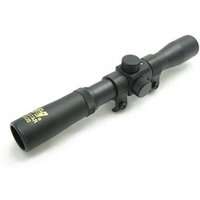
NcSTAR Compact 4x20 Air Gun Rifle Scope, Black, Duplex Reticle - SCA420B
via OpticsPlanet
$12.99

Barska 4X20 Rimfire Rifle Scope, Black Matte AC10730
via OpticsPlanet
$18.99

Daisy Powerline Airgun Scope, 4x15, Crosshair Reticle, Black, 980808-444
via OpticsPlanet
$20.99
Buying Advice
Start with the specs that actually shape your experience. For a red dot, MOA dot size matters: a 2 MOA dot is precise enough for 200-yard headshots on steel yet still fast at close range, while a 6 MOA dot is CQB-fast but covers roughly 6 inches of target at 100 yards. For a magnifier, check the eye relief — anything under 2.5 inches will be punishing under recoil or fast transitions. LPVOs live and die by optical quality at 1×: look for edge-to-edge clarity, minimal fisheye distortion, and a daylight-visible illuminated center dot (often rated at 50,000+ hours on medium). Prism scopes should list their eye relief explicitly; many are surprisingly forgiving at 3-4 inches despite the compact package. Across all three platforms, confirm the reticle plane: most LPVOs under $500 are SFP (second focal plane), meaning the reticle subtensions are accurate only at one magnification — typically max power. FFP (first focal plane) reticles stay true at every zoom level, which matters if you range or hold off targets at partial magnification. For red dots and fixed prisms, focal plane is irrelevant since there is no zoom.
Budget tiers look different for each setup. In the entry tier ($150-$300 total), you can pair a Bushnell or Vortex Crossfire red dot with a budget 3× magnifier and get a genuinely functional rig. Entry LPVOs like the Vortex Strike Eagle 1-6× or Bushnell AR Optics 1-8× land in the $200-$350 range but may lack a truly daylight-bright center dot. Entry prisms, such as the Vortex Spitfire series, offer impressive quality for around $200-$300. At mid-tier ($400-$800), you unlock noticeably better glass, better turret feel, and brighter illumination — think Vortex Viper PST II, Leupold Mark 3HD, or Athlon Ares ETR-class optics. Premium setups ($900-$2,000+) from Nightforce, Leupold, or Swarovski deliver edge-to-edge sharpness, bombproof tracking, and coatings that pull maximum light in dawn and dusk conditions when game movement peaks.
The most common mistake is choosing based on someone else's mission profile. A 1-8× LPVO makes little sense on a 10.5-inch .300 Blackout SBR built for home defense — you are adding 18+ oz for magnification you will likely never use indoors. Conversely, putting a bare red dot on a 20-inch SPR-style 5.56 rifle and trying to ring 500-yard steel is an exercise in frustration. Another frequent error is ignoring mount quality: a $50 cantilever mount can undo everything a $600 LPVO offers if it flexes, shifts zero, or strips screws. Budget at least $80-$150 for a reputable mount from Vortex, Leupold, Aero Precision, or similar. Finally, do not forget to account for astigmatism — if you see a starburst when looking through a red dot at the store, a prism scope or an LPVO with an etched reticle insert will serve you far better.
US context matters for this decision. Most AR-15 owners shoot 5.56/.223 Rem, and the overwhelming majority of practical engagements — whether steel challenge, carbine class, home defense, or varmint and predator control — happen inside 300 yards. At these distances any of the three setups can deliver hits on demand, so weight, speed to first shot, and eye box comfort often matter more than raw magnification. For 3-Gun competitors running stages from 1 to 400 yards, the LPVO has become nearly mandatory. For coyote hunters in open western terrain who might take 400+ yard shots, a 1-10× LPVO or a magnified prism paired with a canted red dot is worth considering. Purchase options are broad: Amazon.com stocks nearly every optic mentioned here (look for the manufacturer's authorized dealer badge), and OpticsPlanet often runs combo deals on optic-plus-mount packages. Always verify warranty coverage — Vortex's unconditional VIP warranty and Leupold's lifetime guarantee are standout policies for US buyers.
Matching the optic to your actual use case is the single best way to avoid buyer's remorse. Build a quick mental checklist: What is the longest realistic shot I will take? Will I shoot in low light (dawn/dusk hunts, indoor ranges)? Do I have astigmatism? Is weight a hard constraint (long hikes, patrol)? Am I running suppressed, and if so will heat mirage reduce the value of high magnification? For a general-purpose 16-inch 5.56 carbine that might do everything from a weekend steel match to a nightstand role, a 1-6× LPVO on a lightweight mount is the Swiss-army-knife answer. For a truck gun or bedside carbine that will never shoot past 100 yards, a red dot — or a 1× prism if astigmatism is an issue — saves weight, money, and complexity. The magnifier is the modular middle ground: leave it at home when you don't need it, flip it up when you do.
A brief brand landscape for 2026: Vortex dominates the value-to-performance conversation across all three categories, from the Sparc Solar red dot to the Razor Gen III 1-10× LPVO. Leupold's Freedom RDS and Patrol 6HD lines are manufactured or assembled in Oregon and carry strong appeal for buyers who prioritize US-made optics. Athlon has quietly earned respect with LPVOs like the Cronus BTR and Ares ETR offering FFP reticles and exposed turrets at prices well under Nightforce or Swarovski equivalents. Nightforce remains the gold standard for duty-grade optics — their NX8 1-8× is widely considered the benchmark LPVO in terms of optical quality per ounce. Bushnell rounds out the entry tier with dependable optics backed by decades of institutional knowledge. Whichever brand you choose, prioritize a reputable warranty and confirmed US dealer authorization to protect your investment.
Frequently Asked Questions
Can I use a red dot with a magnifier for 3-Gun competition?
You can, but you will be at a disadvantage on long-range stages. Most 3-Gun courses include targets at 300-400+ yards, where a 3× magnifier limits your ability to identify and precisely engage small steel. A 1-6× or 1-8× LPVO is the preferred choice for competitive 3-Gun because it gives you both CQB speed on 1× and enough magnification to make 400-yard hits confidently. If your local matches stay inside 200 yards, a red dot and magnifier will be competitive.
What is the best optic setup for an AR-15 if I have astigmatism?
A prism scope is typically the best answer. Because prism optics use an etched reticle on glass — rather than a projected LED dot — the aiming point appears crisp and sharp regardless of your eye's astigmatism. An LPVO also uses etched reticles and works well. If you prefer a red dot form factor, look for holographic sights (like EOTech), which many astigmatic shooters report as clearer than traditional LED reflex sights. Always test in person if possible before committing.
How much does an LPVO weigh compared to a red dot and magnifier combo?
A typical 1-6× LPVO with mount weighs 18-24 oz, while a premium 1-8× or 1-10× with mount can reach 26-30 oz. A red dot plus flip-to-side 3× magnifier generally comes in at 10-16 oz total, depending on the models. That 8-14 oz difference is significant on a carbine you carry all day. If weight is your primary concern and you can accept limited magnification, the red dot and magnifier combo wins decisively.
Is a 1× prism scope as fast as a red dot at close range?
Close, but not quite. A true 1× prism scope has a small eye box compared to a reflex red dot, meaning you need more precise head placement behind the optic to see a full, clear sight picture. In fast transitions or awkward shooting positions, a red dot's nearly unlimited eye relief gives it an edge. That said, modern 1× prisms from Vortex and others have improved dramatically, and many shooters find the difference negligible with practice.
Do I need an FFP or SFP reticle in an LPVO for my AR-15?
For most AR-15 shooters using a 1-6× or 1-8× LPVO, SFP (second focal plane) works perfectly fine. The reticle subtensions — BDC hashmarks, mil dots, or MOA lines — are accurate at max power, which is where you will be when making precise shots. FFP reticles stay accurate at every magnification, which matters more for long-range PRS-style shooting where you may range or hold off at partial zoom. FFP LPVOs also tend to cost more and may have a reticle that appears very small at 1×.
What magnifier power works best with a red dot on an AR-15?
A 3× magnifier is the most popular and practical choice. It turns a 2 MOA dot into a visible but not oversized aiming point and provides enough magnification to identify targets and make hits to 200-300 yards with 5.56 NATO. Some companies offer 5× and 6× magnifiers, but these tend to have tighter eye boxes and heavier weight. Unless you regularly need to identify or engage targets past 300 yards, 3× is the sweet spot for carbine use.
Can I mount a prism scope and a red dot together on an AR-15?
Yes, and it is an increasingly popular setup. A 3× or 5× prism scope as the primary optic paired with a micro red dot on a 45-degree offset mount gives you both magnified precision and fast CQB capability. This combination weighs less than many LPVOs and provides the etched-reticle benefit of the prism. The trade-off is added rail clutter and the need to practice transitioning between the two sighting systems, but many practical shooters and hog hunters find it extremely effective.
How far can I realistically shoot with each setup on a 5.56 AR-15?
With a bare red dot (no magnifier), most shooters can consistently hit a torso-sized steel plate to 200 yards and a skilled shooter can stretch to 300. Adding a 3× magnifier extends practical accuracy to roughly 300-400 yards. A 1-6× LPVO pushes that to 400-500 yards with good ammunition, and a 1-8× or 1-10× can reach 600+ in trained hands. A 3× prism is comfortable to 300 yards, while a 5× prism can reach 400-500. Remember that 5.56 NATO drops roughly 35-40 inches at 500 yards with 62-grain ammo, so holdover knowledge or a BDC reticle is essential at distance.
Which setup is best for home defense on an AR-15?
A red dot — or a 1× prism if you have astigmatism — is the optimal home-defense optic. Indoor engagement distances are typically under 15 yards, where magnification is irrelevant and speed to first shot is everything. A quality red dot offers unlimited eye relief, fast both-eyes-open acquisition, and minimal weight. Adding a magnifier or LPVO for a dedicated home-defense gun adds cost, weight, and complexity with no practical benefit at hallway distances. Keep it simple and train with what you mount.
Related guides
Best red dot sights for AR-15 pistol and home-defense builds in 2026 — 2 MOA vs 6 MOA dot size, battery life, cowitness height…
LPVO Mount Heights, Cantilever Offset & Piggyback DotsUnderstand LPVO mount heights from 1.54" to 2.26", cantilever offset, and piggyback red dots. US-focused 2026 guide with brand picks, specs…
MPVO vs LPVO: Which Variable Scope Belongs on Your AR-15 or Hunting Rifle?MPVO scopes (2-10x, 2-12x, 3-15x) bridge the gap between LPVO and high-power glass. Learn which magnification range fits your AR-15 or hunting rifle…
Mk Machining Scope Cap Warranty: What US Buyers Need to KnowMk Machining scope cap warranty issues explained. Learn how to file claims, find alternatives, and protect your rifle scope investment in 2026.
Not sure which scope is right for you?
Try our AI-powered scope finder — answer a few questions and get personalised recommendations.
Find My Scope →Get a scope tip every day
Follow AiScopes on Facebook for daily buying guides, deals and gear advice.
Follow on Facebook