Savage MkII Scope Upgrades That Actually Matter
By Peter Makulek · Senior Optics Editor · · Live prices from US retailers
Quick answer: the single best optical upgrade for a Savage MkII is a quality 3-9×40 or 4-16×44 rimfire scope with a parallax adjustment set at 50 yards — not 100. The Vortex Crossfire II 2-7×32 Rimfire (with a factory 50-yard parallax setting) or the Leupold FX-3 6×42 are proven performers on this platform, typically running $150–$300 and delivering sub-MOA clarity at the distances where a .22 LR actually shines.
The Savage MkII is one of the most popular bolt-action .22 LR rimfire rifles in the United States, beloved by plinkers, small-game hunters, and Appleseed shooters alike. Its AccuTrigger and solid action make it punch well above its price class — but the factory iron sights or bundled optics rarely do the rifle justice. Upgrading the scope is the single highest-impact modification you can make, and choosing the right one requires understanding a few rimfire-specific optical details that differ from centerfire shopping.
Why does the scope matter so much on a MkII? A .22 LR bullet typically exits the muzzle around 1,050–1,260 ft/s (standard and high-velocity loads), with significant drop beyond 75 yards. At 100 yards, most loads drop 3–4 inches below a 50-yard zero; by 150 yards, you may see 15+ inches of drop. A scope with precise, repeatable turrets and a reticle you can actually hold with — whether MOA hash marks or MRAD dots — turns a fun plinker into a genuine precision trainer. For coyote hunting or longer-range shooting drills, that precision is non-negotiable.
This guide covers every angle: FFP versus SFP for rimfire, correct parallax settings, how to match magnification to your shooting discipline, and whether night vision or thermal optics make sense on a .22 LR platform for hog hunting or predator control. We also address air rifle scopes — because many of the same optics work on springers and PCPs, but with important caveats about recoil profiles and realistic effective range (50–75 yards for sub-12 ft-lb air rifles). All product suggestions are available through US retailers including Amazon.com and OpticsPlanet.
Top Picks — Live US Prices
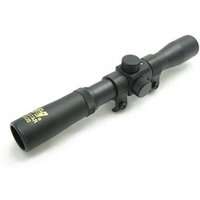
NcSTAR Compact 4x20 Air Gun Rifle Scope, Black, Duplex Reticle - SCA420B
via OpticsPlanet
$12.99

Barska 4X20 Rimfire Rifle Scope, Black Matte AC10730
via OpticsPlanet
$18.99

Daisy Powerline Airgun Scope, 4x15, Crosshair Reticle, Black, 980808-444
via OpticsPlanet
$20.99
Buying Advice
Start with the specs that actually matter for rimfire. Parallax is the single most misunderstood setting: most centerfire scopes ship with parallax fixed at 100 yards, which means at 25–50 yards — where most rimfire shooting happens — you will see a blurry reticle or shifting point of aim as your eye moves behind the scope. Look for scopes with an adjustable objective (AO) or side-focus parallax that goes down to 10–25 yards, or a fixed parallax factory-set at 50 yards. A 1-inch tube is perfectly adequate for a .22 LR; you do not need a 30mm or 34mm tube unless you plan to mount a scope that doubles on a larger platform later. Objective lens diameter of 32–44mm keeps the scope compact and light — important on a rifle that weighs about 5.5 pounds.
Budget tiers break down clearly. Entry-level ($80–$150) gets you reliable glass from Bushnell's Banner or Rimfire lines and the Vortex Crossfire II Rimfire — adequate optics with proper parallax, backed by lifetime warranties. Mid-range ($150–$350) opens up the Leupold VX-Freedom Rimfire, Vortex Diamondback Tactical in a 4-16×44 FFP configuration, and select Bushnell Engage models; these scopes offer capped or exposed turrets with reliable tracking, better edge-to-edge clarity, and often illuminated reticles. Premium ($350–$700+) territory includes the Leupold VX-3HD, Zeiss Conquest V4, and Kahles Helia — optics that are frankly overkill for most MkII shooters but deliver exceptional light transmission for dawn-dusk coyote hunting or benchrest-level rimfire competition.
The most common mistake buyers make is over-scoping. A 6-24×50 FFP tactical scope on a Savage MkII weighs nearly as much as the rifle, shifts the balance point forward, and provides magnification you will never need at realistic .22 LR distances. Worse, heavy centerfire-grade optics sometimes have minimum parallax settings of 50 or even 75 yards, which defeats the purpose. Another frequent error is ignoring recoil direction on air rifles: spring-piston air rifles produce a unique double-pulse, rearward-then-forward recoil that destroys scopes not rated for springer use. If you are sharing optics between a MkII and a spring-piston air rifle, confirm the scope is springer-rated. PCP and CO2 air rifles are recoilless, so any rimfire scope works.
For US-specific use cases, consider your discipline. Appleseed and NRL22 competitors typically want an SFP scope in the 4-16× range with exposed MOA turrets so they can dial elevation precisely at 25, 50, and 100 yards — the standard course-of-fire distances. Small-game and squirrel hunters in eastern hardwoods rarely shoot past 50 yards and do well with a fixed 4× or 6× optic that is light and fast. Coyote hunters in the West who use a .22 LR as a secondary or training rifle (with a .223 or 6.5 Creedmoor as the primary long-range rig) often mount a thermal or night vision clip-on for predator control after dark — the Hikmicro Thunder series or a Bushnell Equinox are popular entry-level options, though dedicated thermal scopes from Hikmicro or Pulsar easily cost more than the rifle. For hog hunting specifically, a thermal scope is increasingly standard in states like Texas and Oklahoma where nighttime harvest is legal year-round; just be aware that mounting a $2,000+ thermal unit on a $250 rimfire is rarely the right play — most hog hunters pair thermals with a centerfire AR-platform rifle in .300 Blackout or .308.
From a brand-landscape perspective, Vortex dominates the value segment with an unconditional lifetime warranty and a deep rimfire-specific lineup; their VIP warranty is transferable, which helps resale value. Leupold's US-made optics carry patriotic cachet and genuinely excellent glass, though they tend to cost 15–25% more than comparable Vortex models. Bushnell covers the budget end competently. For shooters who want best-in-class European glass on a rimfire trainer — perhaps to replicate the sight picture of their centerfire hunting scope — Zeiss, Kahles, Swarovski, and March all make compact models that fit a MkII, but you are paying for optical perfection that a .22 LR's inherent accuracy limits may not fully exploit. Buy from Amazon.com for fast Prime shipping and easy returns, or from OpticsPlanet for wider selection and occasional bundle deals (rings + scope combos). The aiscopes.us dealer locator can also help you find a local shop across all 50 states where you can put eyes through glass before buying.
Frequently Asked Questions
What parallax setting should a Savage MkII scope have?
Ideally, choose a scope with an adjustable parallax (AO or side focus) that dials down to at least 10–25 yards, because most rimfire shooting happens between 25 and 100 yards. If you prefer a fixed-parallax scope, look for one factory-set at 50 yards — not the 100-yard or 150-yard setting common on centerfire models. Incorrect parallax causes apparent reticle shift as your eye moves, which adds 1–2 MOA of aiming error at close range. This is the single most overlooked spec when scoping a .22 LR.
FFP or SFP — which is better for a rimfire rifle like the MkII?
For most MkII shooters, SFP (second focal plane) is the better choice. SFP scopes keep the reticle the same apparent size at all magnifications, which is easier on the eye at the lower magnifications (3–6×) commonly used in rimfire shooting. FFP scopes are useful if you plan to hold off using reticle subtensions at varying power, but at rimfire distances (25–150 yards), you rarely need that capability. NRL22 competitors who dial turrets rather than hold may prefer SFP for this reason.
Can I use a night vision or thermal scope on a Savage MkII for predator hunting?
Yes, and it is increasingly popular for coyote hunting in states that allow night hunting with artificial light or electronic optics. A digital night vision scope like the Bushnell Equinox or Sightmark Wraith can mount directly on the MkII's Weaver/Picatinny rail. Thermal scopes from Hikmicro or Pulsar offer superior target detection in total darkness. However, a .22 LR is marginal for coyotes and not adequate for hog hunting — most experienced predator and hog hunters pair thermal optics with a centerfire rifle for ethical kills.
MOA or MRAD turrets — which should I pick for a .22 LR scope?
MOA is more intuitive for US shooters because adjustments correspond neatly to inches: 1 MOA equals approximately 1.047 inches at 100 yards, so a ¼ MOA click moves the point of impact roughly 0.26 inches at that distance. MRAD (mil-radian) turrets work in metric-friendly units — 0.1 mil equals 1 cm at 100 meters — and are standard in PRS/tactical circles. For a Savage MkII used in NRL22 or Appleseed, MOA is the more common convention; for shooters training to transition to a centerfire PRS rifle, MRAD builds good habits early.
Will a scope rated for centerfire rifles survive on a spring-piston air rifle?
Not necessarily. Spring-piston (springer) air rifles produce a unique bidirectional recoil — rearward then sharply forward — that destroys scopes designed only for the single rearward pulse of a firearm. If you plan to swap your MkII scope onto a break-barrel springer, verify it is explicitly rated for spring-piston recoil. PCP and CO2 air rifles produce virtually no recoil, so any rimfire or centerfire scope works safely on those platforms. Realistic effective range for sub-12 ft-lb air rifles is 50–75 yards, so high magnification is rarely needed.
What magnification range is ideal for a Savage MkII?
A 3-9× or 4-12× variable is the sweet spot for the vast majority of MkII owners. At 25 yards, 3–4× gives a wide field of view for reactive steel; at 100 yards, 9–12× provides enough resolution to see .22-caliber holes on paper. Going beyond 16× is unnecessary for most rimfire work and adds weight and cost. Fixed-power 4× or 6× scopes are excellent lightweight options for small-game hunting in eastern woods where shots are typically under 50 yards.
How much should I spend on a scope for a Savage MkII?
A common rule of thumb is to spend at least as much on the optic as you did on the rifle. Since most MkII models retail in the $200–$350 range, a scope budget of $150–$350 hits the sweet spot — covering excellent options from Vortex, Leupold, and Bushnell. Going below $80 typically means poor glass coatings and unreliable tracking. Going above $500 delivers diminishing returns unless you are competing in rimfire benchrest or want to replicate a premium centerfire sight picture for training purposes.
Do I need a zero stop on a rimfire scope?
A zero stop is a nice-to-have but not essential for rimfire. Zero stops let you dial elevation up for distance and then quickly return to your confirmed zero by feel. They are most valuable in competition formats like NRL22 where you engage targets at multiple known distances in a timed stage. For casual plinking or hunting at a single known distance, a standard capped turret is simpler and less expensive. Most rimfire-specific scopes under $300 do not include a zero stop.
What rings or mount do I need for the Savage MkII?
The Savage MkII uses a 3/8-inch dovetail rail machined into the receiver (not Picatinny/Weaver). You need dovetail-compatible rings or a dovetail-to-Picatinny adapter rail. Low or medium rings usually provide proper clearance for 32–40mm objective lenses. Weaver-style turn-in rings or Leupold Rifleman dovetail rings are affordable, proven options. If you add a Picatinny adapter, the full universe of tactical ring and mount options opens up, though the added height may require a cheek riser for proper eye alignment.
Related guides
Nikon rimfire scopes were legendary, but the line is discontinued. We cover what made them great and the best alternatives for .22LR in 2026 for US…
Best Scopes for Long-Range Rimfire on a CZ 457 MTRFind the best scope for long-range rimfire shooting on a CZ 457 Varmint MTR. We cover FFP reticles, turret quality, parallax…
Best Scopes for the CZ 457 in 2026Find the best scope for your CZ 457 in 2026. We cover budget, mid-tier, and PRS-rimfire competition optics with adjustable parallax, turret quality…
Not sure which scope is right for you?
Try our AI-powered scope finder — answer a few questions and get personalised recommendations.
Find My Scope →Get a scope tip every day
Follow AiScopes on Facebook for daily buying guides, deals and gear advice.
Follow on Facebook