Schmidt & Bender PM II SFP: Understanding the Double-Turn Turret
By Peter Makulek · Senior Optics Editor · · Live prices from US retailers
Quick answer: The Schmidt & Bender PM II SFP's double-turn (DT) turret is not a defect — it is an intentional design that gives you roughly 26 MRAD (or the full MOA equivalent) of total elevation travel across two full revolutions, with a subtle visual and tactile indicator at the halfway mark so you always know which revolution you are on. If you want one-turn simplicity, you need the optional single-turn (ST) turret or a different scope entirely.
The PM II is one of the most respected tactical and long-range rifle scopes ever made, used by military units worldwide and highly sought after by US precision rifle shooters. Schmidt & Bender offers it in both first focal plane (FFP) and second focal plane (SFP) configurations. The SFP variant is less common in the US PRS community — most competitors default to FFP — but it has a devoted following among military and law-enforcement marksmen who prefer a clean, uncluttered reticle image at lower magnifications and only range or hold at max power. The double-turn turret on this model confuses new owners because most competing scopes in this price class now ship with tall, single-revolution turrets or locking designs.
Understanding why S&B chose a double-turn layout matters if you are building a precision rig around this optic. A double-turn turret keeps the turret housing physically shorter and more snag-resistant — a real advantage on a duty rifle carried through brush, vehicles, or confined spaces. The tradeoff is that you must track which revolution you are on during a rapid engagement sequence. S&B addresses this with a color-coded or numbered indicator ring visible between the turret cap and the saddle. Some US shooters add aftermarket turret caps or upgrade to the newer single-turn housing to simplify things, but neither solution is strictly necessary once you train on the system.
For US hunters pursuing coyotes at extended range or for anyone stepping into long-range shooting competitions, the PM II SFP double-turn turret is a premium solution that rewards deliberate, disciplined shooting. If you are coming from a Vortex Razor, Nightforce ATACR, or Leupold Mark 5HD — all of which default to tall single-turn turrets — the transition requires a few range sessions. Below, we cover every detail: how the turret works mechanically, what to watch for when buying, how it compares to alternatives, and which accessories US shooters actually need.
Top Picks — Live US Prices
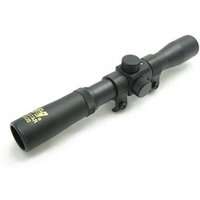
NcSTAR Compact 4x20 Air Gun Rifle Scope, Black, Duplex Reticle - SCA420B
via OpticsPlanet
$12.99

Barska 4X20 Rimfire Rifle Scope, Black Matte AC10730
via OpticsPlanet
$18.99

Daisy Powerline Airgun Scope, 4x15, Crosshair Reticle, Black, 980808-444
via OpticsPlanet
$20.99
Buying Advice
The key specification to understand is total elevation travel versus travel per revolution. Most modern long-range scopes like the Nightforce ATACR 7-35×56 or the Vortex Razor HD Gen III give you roughly 30+ MRAD of total elevation in a single tall turret revolution. The Schmidt & Bender PM II SFP splits that travel across two shorter revolutions — roughly 13 MRAD per turn in a mil-based model, or approximately 46–50 MOA per turn in MOA versions. Each click is 0.1 MRAD (1 cm at 100 meters, or about 0.36 inches at 100 yards) or 0.25 MOA (~0.26 inches at 100 yards), depending on the model you choose. The zero-stop mechanism engages at your chosen zero, preventing you from dialing below it. Always confirm whether your PM II has the zero stop installed — older models may not.
Budget tiers in the precision-optic world look very different once you are shopping Schmidt & Bender. Entry-level long-range scopes from Vortex (Diamondback Tactical) or Bushnell (Match Pro) sit in the $300–$600 range and use exposed turrets with simple zero-stop systems. Mid-tier optics like the Arken EP5 series, Bushnell XRS3, or the Vortex Viper PST Gen II occupy the $600–$1,500 bracket and deliver excellent glass with tall single-turn turrets. The PM II sits firmly in the premium tier alongside the Nightforce ATACR and Zeiss LRP S3, typically running $2,500–$4,000+ depending on reticle and turret configuration. At this level, you are paying for bombproof mechanical reliability, optically perfect glass, and a decades-long service track record.
The most common mistake US buyers make with the PM II SFP double-turn turret is assuming it is broken or mis-configured out of the box. The turret intentionally does not have the oversized, knurled grip found on American-designed PRS scopes — it is deliberately low-profile. Another frequent error is failing to set the zero stop properly before heading to the range. S&B's zero-stop system requires you to remove the turret cap, adjust the stop ring, and re-seat everything precisely. If you skip this step, you will lose your reference point between revolutions. Finally, some shooters buy the SFP model thinking the reticle will subtend at all magnifications — it will not. The reticle is only dimensionally accurate at the highest magnification, typically 12× or 25× depending on the model.
For US-specific use cases, consider what you are actually doing with this scope. A PRS competitor shooting stages at 400–1,200 yards will generally prefer FFP and a tall single-turn turret — the PM II FFP with the ST turret or an ATACR may suit better. A law-enforcement or military marksman who needs a clean SFP reticle for fast target ID at 4× or 5× and only dials at max power for a deliberate shot will love the PM II SFP. Coyote hunters working the arid West at 200–500 yards will appreciate the compact turret profile when pulling the rifle from a truck or ATV. For hog hunting at closer range or night-vision work, you may want to explore clip-on night-vision or thermal devices from Pulsar or HikMicro that mount ahead of the PM II's objective — the SFP reticle pairs well with clip-on NV since the reticle stays visible at all magnifications. You can find the PM II and compatible accessories on Amazon.com or through specialty dealers listed on our 50-state dealer locator at aiscopes.us.
In the broader brand landscape for 2026, Schmidt & Bender remains the benchmark European precision optic, competing directly with Nightforce (US-assembled), Zeiss (German), and the top tiers of Leupold and Vortex. Nightforce's ATACR and NX8 lines offer tall single-turn turrets and FFP as standard, making them the default choice for many US PRS shooters. Leupold's Mark 5HD is lighter and offers a US-made option with a similarly excellent zero-stop. Vortex's Razor HD Gen III is arguably the most popular US competition optic in this class. Where S&B differentiates is build quality, glass clarity at extreme magnification, and the sheer mechanical precision of its turret system — the double-turn included. If you value a compact turret profile, European optical engineering, and a scope trusted by NATO snipers, the PM II SFP with the double-turn turret is not weird at all — it is a deliberate, battle-proven design choice.
Frequently Asked Questions
Why does the Schmidt & Bender PM II SFP have a double-turn turret instead of a single turn?
S&B designed the double-turn turret to keep the housing physically shorter and more snag-resistant, which is critical on military and duty rifles. It splits the total elevation travel across two revolutions, with an indicator ring to show which revolution you are on. This is not a flaw — it is an intentional European military design philosophy that prioritizes compactness over the tall, single-turn turrets common on American PRS scopes.
Can I convert my PM II SFP double-turn turret to a single-turn turret?
Yes. Schmidt & Bender offers a single-turn (ST) turret housing as an upgrade or factory option. You can also send your scope to S&B's US service center or an authorized dealer for the conversion. Be aware that switching to a single turn reduces total available elevation travel per revolution, which may limit your usable range depending on caliber and zero distance.
How do I know which revolution I am on with the double-turn turret?
S&B uses a visual indicator — typically a colored ring or numbered marking visible between the turret cap and the saddle — that changes position or reveals a different color when you pass from the first revolution to the second. Some models also include a tactile click or slight resistance at the transition point. With a few range sessions, tracking your revolution becomes second nature.
Is the PM II SFP a good choice for long-range shooting competitions in the US?
It can be, but most US PRS and NRL competitors prefer FFP scopes because the reticle subtension is accurate at every magnification, allowing holds at any power. The PM II SFP reticle is only dimensionally correct at its highest magnification. If you always dial your turret rather than holding, and you shoot at max power, the SFP model works fine. For pure competition optimization, the PM II FFP or competing FFP scopes from Nightforce or Vortex are more popular choices.
Is there a new Arken 2-12 SFP scope, and how does it compare to the PM II SFP?
Arken has been expanding its SFP lineup, and a 2-12× model has been discussed in the shooting community. If released, it would likely sit in the $400–$700 range — a fraction of the PM II's cost. Arken delivers impressive value with quality glass and functional turrets, but it will not match the PM II's mechanical precision, optical clarity, or proven durability. Think of the Arken as an excellent entry into SFP precision shooting and the PM II as the endgame.
Can I use a clip-on night-vision or thermal device with the PM II SFP?
Absolutely. The PM II SFP pairs very well with clip-on night-vision units from brands like Pulsar or HikMicro because the SFP reticle remains visible and uncluttered regardless of magnification. Mount the clip-on device ahead of the objective lens. This setup is popular among US hog hunters and predator hunters who need to transition between daytime and nighttime use without swapping optics. Ensure your mount system provides enough rail space for both the scope and the clip-on.
What calibers and platforms work best with the PM II SFP double-turn turret?
The PM II SFP is most commonly mounted on bolt-action precision rifles in 6.5 Creedmoor, .308 Winchester, and .300 Win Mag — calibers that dominate US long-range and tactical shooting. The double-turn turret provides enough elevation for shots well past 1,000 yards with these cartridges. It also works on semi-auto platforms like the AR-10/SR-25 family, though you should use a quality mount from a brand like Spuhr or Badger Ordnance to handle recoil reliably.
Is the PM II SFP suitable for coyote hunting or is it overkill?
It depends on your priorities. For dedicated coyote hunting at 200–500 yards in open Western terrain, the PM II SFP is optically superb and its compact double-turn turret is snag-resistant when moving through brush. However, most coyote hunters do not need a $3,000+ scope. Excellent results can be had with mid-tier optics from Vortex, Leupold, or Bushnell in the $500–$1,200 range. If you already own the PM II or want one scope for both precision competition and predator hunting, it will excel at both.
Should I choose MOA or MRAD on the PM II SFP?
In the US, both systems have strong followings. MOA is intuitive for shooters who think in inches — 1 MOA equals approximately 1.047 inches at 100 yards. MRAD (mil) is the global military standard and is slightly easier for quick math at various distances: 0.1 MRAD equals 1 cm at 100 meters or roughly 0.36 inches at 100 yards. Most US PRS competitors have moved to MRAD. Choose whichever matches your existing ballistic data, turret preferences, and range buddy ecosystem.
Related guides
FFP vs SFP explained: how reticle subtensions hold at every magnification, which disciplines favor each, and why FFP costs more. A 2026 buyer's guide.
Nikon Rimfire Scopes: What Happened & What to Buy InsteadNikon rimfire scopes were legendary, but the line is discontinued. We cover what made them great and the best alternatives for .22LR in 2026 for US…
Not sure which scope is right for you?
Try our AI-powered scope finder — answer a few questions and get personalised recommendations.
Find My Scope →Get a scope tip every day
Follow AiScopes on Facebook for daily buying guides, deals and gear advice.
Follow on Facebook