Scope Rail Help — Choosing the Right Base & Mount
By Peter Makulek · Senior Optics Editor · · Live prices from US retailers
Quick answer: for most modern US bolt-action and AR-platform rifles, a one-piece Picatinny (MIL-STD-1913) rail is the best starting point — it gives you a full 20-MOA cant option, universal mount compatibility, and rock-solid return-to-zero. Pair it with quality 30mm or 34mm rings matched to your scope tube diameter and you are set for everything from 100-yard whitetail stands to 1,000-yard PRS stages.
Scope rail confusion is the number-one reason new shooters buy parts that do not fit. The core issue is that there are several rail standards — Picatinny, Weaver, dovetail (3/8-inch and 11mm), and proprietary systems — and they are not all interchangeable. A Weaver-width mount will physically slide onto a Picatinny rail but the cross-slot spacing differs, so torque and recoil-resistance may suffer. Dovetail bases found on rimfire rifles and many air rifles use a completely different clamping geometry and will never accept a Picatinny ring. Understanding these differences before you order saves time, money, and frustration.
Why it matters for US shooters specifically: American rifle diversity is enormous. A Remington 700 ships drilled-and-tapped for two-piece Weaver or Picatinny bases. A Ruger 10/22 rimfire has a proprietary integral rail. Many Savage actions use the Accutrigger-era 8-40 screw pattern. And AR-15 and AR-10 flat-top upper receivers come with a Picatinny rail machined directly into the forged aluminum. Each platform demands a rail or base that matches its screw pattern and action length, so the first step is always identifying your rifle's receiver before shopping for optics hardware.
Key decision factors include rail material (aluminum vs. steel), cant angle (0 MOA for short-range, 20 MOA for long-range to preserve elevation travel), rail length (enough slots for your chosen mount or rings), and height — which determines how much clearance your objective lens gets above the barrel or handguard. Getting this wrong can leave you unable to zero, unable to see through the scope without straining your neck, or worse, with a scope that physically contacts the barrel under recoil.
Top Picks — Live US Prices
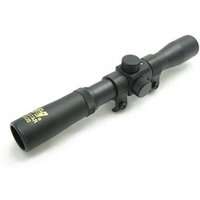
NcSTAR Compact 4x20 Air Gun Rifle Scope, Black, Duplex Reticle - SCA420B
via OpticsPlanet
$12.99

Barska 4X20 Rimfire Rifle Scope, Black Matte AC10730
via OpticsPlanet
$18.99

Daisy Powerline Airgun Scope, 4x15, Crosshair Reticle, Black, 980808-444
via OpticsPlanet
$20.99
Buying Advice
Start by measuring what you already have. Scope tube diameter — 1 inch, 30mm, or 34mm — determines ring size. Never assume; a 30mm ring on a 1-inch tube will never clamp safely, and forcing a 34mm tube into 30mm rings is impossible. Check your receiver's screw-hole pattern: Remington 700s use 6-48 screws, many Savage short actions use 8-40, and Tikka T3x rifles use their own proprietary spacing. If your rifle already has a rail attached, measure the slot width: Picatinny slots are 0.206 inches wide on 0.394-inch centers; Weaver slots are the same width but spaced irregularly. A dovetail rail on a rimfire or air rifle has no slots at all — it relies on a friction clamp and sometimes a cross-pin.
Budget tiers break down clearly. Entry-level aluminum Picatinny rails from brands like Burris and Weaver run roughly $25–$60 and work perfectly well for hunting rifles that see moderate recoil and are zeroed once per season. Mid-range options ($60–$150) include one-piece steel bases from Nightforce, steel Picatinny rails with integral recoil lugs, and skeletonized rails that shave weight for competition. Premium rails ($150–$350+) come from makers like Nightforce, Spuhr, and Badger Ordnance — they feature tight-tolerance machining, hardcoat anodizing, and guaranteed 20-MOA cant precision for long-range or PRS use. Rings follow a similar spread: budget Vortex or Burris rings start around $30, while Nightforce Ultralight or Spuhr one-piece mounts range from $200 to $450+.
The most common mistake is buying a mount or rings without confirming scope tube diameter, rail standard, and objective bell clearance. Another frequent error: choosing a 0 MOA rail for a long-range rig that needs every click of elevation. If your scope has 60 MOA of total elevation travel, half — 30 MOA — is available above mechanical center. Mounting it on a 20-MOA canted rail effectively gives you 50 MOA of usable up-elevation at the cost of 10 MOA of down-travel you probably never use. For a .308 Win zeroed at 100 yards, you need roughly 36 MOA of additional elevation to reach 1,000 yards, so that extra cant can be the difference between hitting steel and running out of turret.
US-specific context matters. AR-15 flat-top receivers already have a Picatinny rail segment, so you only need rings or a cantilever mount — no separate base. For bolt guns, Amazon.com stocks a wide selection of Vortex, Leupold, and Burris bases and rings, and OpticsPlanet carries harder-to-find Nightforce and S&B mounts. If you shoot rimfire — say a CZ 457 or Ruger 10/22 — confirm whether your receiver uses an 11mm or 3/8-inch dovetail or a Picatinny rail, because those platforms are split. For thermal or night-vision optics from Pulsar or Hikmicro, most clip-on adapters need a specific diameter ring or bayonet mount, so check the manufacturer's recommended mounting hardware before buying aftermarket.
Matching the choice to your use case is straightforward. Whitetail hunters taking 50- to 150-yard shots from a treestand need a lightweight aluminum base, medium-height rings, and a 1-inch or 30mm hunting scope — a Leupold VX-Freedom on Burris Signature Zee rings is a proven, affordable combination. PRS and long-range shooters pushing past 600 yards benefit from a 20-MOA one-piece steel rail, high-quality 34mm rings or a one-piece mount like a Spuhr, and a first-focal-plane MRAD scope from Nightforce or Vortex. Rimfire and air-rifle shooters should stick with dovetail-compatible rings or a dovetail-to-Picatinny adapter rail, keeping in mind that spring-piston air rifles generate a unique bi-directional recoil that can destroy optics not rated for it. Always torque ring and base screws to the manufacturer's specification with a quality inch-pound torque wrench — over-torquing can warp the scope tube, and under-torquing lets the scope shift under recoil.
A brief brand landscape: Vortex offers exceptional value across all price points and backs everything with an unconditional lifetime warranty — their Pro rings and Precision Matched rings are PRS staples. Leupold's Mark series bases and rings are built in Oregon and remain a top pick for hunters who value American manufacturing. Nightforce produces some of the tightest-tolerance mounts in the industry, favored by military and competitive shooters. Burris Signature rings with their polymer inserts help correct minor alignment issues and are forgiving on budget setups. For dedicated spotting-scope or range-scope tripod adapters, Vortex and Bushnell both offer quick-detach plates that fit standard Arca-Swiss and Picatinny systems, useful for transitioning between a spotting scope and a rifle optic at the range.
Frequently Asked Questions
What is the difference between Picatinny and Weaver scope rails?
Both use a similar slot-and-crossbar design, but Picatinny (MIL-STD-1913) slots are spaced at consistent 0.394-inch centers, while Weaver slots are spaced irregularly. A Weaver-style mount will usually fit on a Picatinny rail because the slot width is the same (0.206 inches), but a Picatinny mount may not align with a Weaver rail's fewer, unevenly placed slots. For maximum compatibility, a Picatinny rail is the safer choice.
What does 20 MOA cant mean on a scope rail?
A 20-MOA canted rail tilts the rear of the scope upward relative to the bore, effectively pre-angling the optic so you consume less internal elevation travel to reach long distances. This gives you roughly 20 extra MOA of usable elevation — critical for long-range shooters who need to dial to 1,000 yards or beyond. For short-range hunting under 300 yards, a 0-MOA flat rail is perfectly adequate.
How do I know what ring height I need for my scope?
Measure your scope's objective bell diameter (e.g., 50mm) and divide by two to get the radius. The ring height must be tall enough that the bottom of the objective bell clears the barrel or rail by at least 1/8 inch. Many manufacturers publish compatibility charts. As a rule, a 50mm objective on a Remington 700 with a Picatinny rail usually needs medium or high rings; a 40mm objective often works with low rings.
I need help identifying a scope part name — what are the main components of a scope mounting system?
The base (or rail) attaches to your rifle's receiver via screws. Rings clamp around the scope tube and bolt onto the base. A one-piece mount combines both into a single unit. Other parts include ring caps (the top halves that tighten down), a recoil lug (a tab that locks the base to the receiver to prevent forward/backward shift), and torque screws. Knowing these names makes it much easier to search for the right hardware.
Can I use Picatinny rings on a rimfire dovetail rail?
Not directly. Rimfire and air rifles typically use an 11mm or 3/8-inch dovetail, which has a completely different profile from a Picatinny rail. You need either dovetail-specific rings or a dovetail-to-Picatinny adapter rail. Adapters from brands like Leupold and Burris are inexpensive — usually under $20 — and give you access to the full range of Picatinny-compatible rings and mounts.
Do I need a one-piece or two-piece scope base?
A one-piece rail spans the full length of the receiver and is inherently more rigid, making it the preferred choice for long-range and tactical use. Two-piece bases are lighter, often less expensive, and allow iron-sight use between the bases on some rifles. For hunting at typical US whitetail distances — under 150 yards — a quality two-piece base is perfectly adequate. For PRS competition or shooting beyond 600 yards, invest in a one-piece Picatinny rail.
What torque specs should I use for scope rings and bases?
Always follow the manufacturer's recommendation, but common values are 15–18 inch-pounds for ring-cap screws and 20–25 inch-pounds for base screws into a steel receiver. Over-torquing ring caps can dent or deform the scope tube, damaging internal erector assemblies. Use a dedicated inch-pound torque wrench — a $25 Wheeler FAT Wrench is the US shooter's go-to tool — and apply a thin layer of blue Loctite 242 on base screws to prevent loosening under recoil.
Are scope mounts and rings restricted on Amazon.com?
Amazon.com does sell scope rings, bases, and rails from major brands like Vortex, Leupold, and Burris. However, Amazon's firearms-accessories policy can occasionally flag certain items. Availability may vary, so if a specific mount is unavailable on Amazon, OpticsPlanet is a reliable US alternative with deep inventory. Always verify compatibility with your specific rifle before purchasing from any retailer.
How do I choose a scope rail for a thermal or night-vision optic?
Thermal scopes from Pulsar and Hikmicro are often heavier than traditional glass optics, so use a robust one-piece Picatinny rail and appropriately rated rings or the manufacturer's recommended mount. Some clip-on thermal or night-vision devices attach in front of your existing daytime scope and require a specific adapter ring sized to your scope's objective bell. Always check the optic's weight and confirm your rail and rings can handle it without shifting under recoil.
Related guides
Master BDC reticles for deer, elk, and coyote hunting. Learn how bullet drop compensating scopes work, which rifle scope fits your caliber…
Steiner T6Xi Magnification: Which Power Range Do You Need?Confused by Steiner T6Xi magnification options? Our 2026 guide breaks down every power range — 1-6x, 2.5-15x, 3-18x, 5-30x…
7mm Rem Mag Scope Problems — Fixes & Best Optics for 2026Having 7mm Rem Mag scope issues? We cover the most common problems — reticle shift, recoil failure, parallax errors…
Not sure which scope is right for you?
Try our AI-powered scope finder — answer a few questions and get personalised recommendations.
Find My Scope →Get a scope tip every day
Follow AiScopes on Facebook for daily buying guides, deals and gear advice.
Follow on Facebook