Zero Distance With a Tall Optic Mount: 50/200 vs 36/300 vs 100 Yards
By Peter Makulek · Senior Optics Editor · · Live prices from US retailers
Quick answer: a taller optic mount raises your line of sight farther above the barrel, and that pushes the second point where your bullet crosses the line of sight farther out. So the famous 50/200 and 36/300 zeros are not fixed rules. They fit one sight height and one load. With a tall mount, the same 50 yard zero gives you a 259 yard second crossing instead of a 207 yard one, and a bullet that rides about 3 inches high in the middle. If you want a simple, repeatable setup, a 100 yard zero works at any sight height. If you want a 200 yard second crossing, move the near zero out as the optic goes up.
Every figure in this guide is computed, not remembered. The assumptions are a 62 grain .224 bullet with a G1 ballistic coefficient of 0.304, a muzzle velocity of 2,900 feet per second, a standard atmosphere at sea level, and a sight height measured from the center of the bore to the center of the scope or sight. We use two sight heights, 2.6 inches and 3.4 inches, as examples of a standard mount and a tall one. Your rifle will differ, so treat these as a map of the pattern and confirm your own zero on paper and steel.
This guide covers what height over bore changes, what barrel length and velocity change, the numbers for 50/200, 36/300 and 100 yard zeros, and why long-range shooters still zero at 100. For LPVO reticles, BDC and first or second focal plane, see our guide to zero distance for LPVO. The picks below are LPVOs from our live US catalog.
Top Picks — Live US Prices
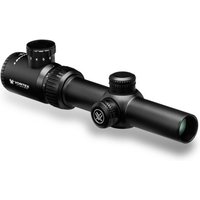
Vortex Crossfire II 1-4x24mm Rifle Scope, 30 mm Tube, SFP, V-Brite Reticle, Anodized Black, 9.6in, 15.6oz, CF2-31037
via OpticsPlanet
$159.99
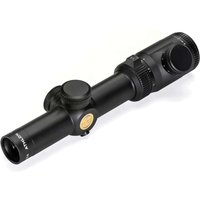
Athlon Optics Talos BTR Gen II 1-4x24mm 30mm Tube Rifle Scope, Second Focal Plane, AHSR14 IR MIL Reticle, Black, 215026
via OpticsPlanet
$187.49
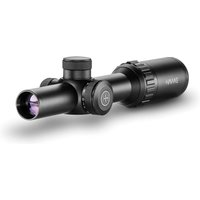
Hawke Sport Optics Vantage Rifle Scope, 1-4x20mm, 1 inch Tube, Second Focal Plane, Turkey Dot IR 1/4 MOA Reticle, Black, 14205
via OpticsPlanet
$190.00
Buying Advice
Start by measuring your own sight height. It is the distance from the center of the bore to the center of the scope tube or the sight window. A quick way is to measure from the center of the muzzle to the center of the front lens of your scope, or to the center of the sight window, with a ruler or calipers. Our LPVO mount height guide covers common heights. Enter the measured number in your ballistic app, because a wrong sight height spoils every number after it.
Why are there two zeros? Because the barrel points slightly upward relative to your line of sight. The bullet leaves the muzzle below the line of sight by your sight height, climbs across it at the near zero, rises to a peak, and falls back across it at a far zero. A 50 yard zero is really a near zero with a far zero somewhere past 200 yards. The taller the sight, the more the barrel has to angle upward, so the bullet climbs higher and takes longer to come back down.
Here are the computed numbers for the 2.6 inch sight height with a 50 yard zero. The bullet is 2.0 inches low at 10 yards and 1.2 inches low at 25. It is 1.4 inches high at 100, 1.6 high at 150 and 0.3 high at 200. It is 2.6 inches low at 250, 7.4 low at 300 and 23.6 low at 400. The highest point is 1.7 inches at 131 yards, and it crosses the line of sight again at about 207 yards. That is where the 50/200 label comes from.
Now the 3.4 inch sight height, also on a 50 yard zero. The bullet is 2.6 inches low at 10 yards and 1.6 low at 25. It is 2.2 high at 100, 3.2 high at 150, 2.7 high at 200 and 0.6 high at 250. Then it is 3.4 low at 300 and 18.0 low at 400. The peak is 3.2 inches at 159 yards, and the far crossing is at about 259 yards. Same rifle, load and zero: the taller mount alone moved the far zero by about 50 yards and the mid-range rise from under 2 inches to over 3.
To get a true 200 yard far zero, the near zero has to change. With these assumptions it comes out at about 31 yards for a 1.5 inch sight height, 52 yards for 2.6 inches and 68 yards for 3.4 inches. At 3.4 inches and a 68 yard zero the bullet is 1.9 inches low at 25 yards, 0.9 high at 100, 1.1 high at 150 and 0.1 low at 200. It is 7.6 low at 300 and 23.5 low at 400, with a peak of 1.2 inches at 134 yards. That is nearly the same shape as the 2.6 inch 50 yard zero. Few ranges have a 68 yard line, which is why many people compromise at 50 or 100.
Now 36/300. With the 2.6 inch sight height, a 36 yard zero crosses again at about 274 yards, not 300, and rises 4.2 inches at its peak around 161 yards. With 3.4 inches, a 36 yard zero crosses at about 338 yards and rises 7.4 inches around 196 yards. To get a 300 yard far crossing with these assumptions you need a near zero of about 33 yards at 2.6 inches and 42 yards at 3.4 inches. A 7 inch rise is a lot for small targets. Treat 36/300 as the label for one setup, not a rule, and on a tall mount expect a bigger rise than the label suggests.
Velocity moves the far zero as much as height does. Keep the 2.6 inch sight height and the 50 yard zero, and change only the muzzle velocity. At 2,600 feet per second the second crossing falls to about 170 yards and the bullet is 12.8 inches low at 300. At 2,900 it is 207 yards and 7.4 inches low. At 3,100 it is 232 yards and 4.7 inches low. Those velocities are illustrations: a shorter barrel or a lighter load sits toward the slow end, a longer barrel or a hotter load toward the fast end. Check your own with a chronograph and a real target.
Now the 100 yard zero. At 2.6 inches the bullet is 1.5 inches low at 25 yards, on at 100, 2.6 low at 200, 11.8 low at 300 and 29.3 low at 400. At 3.4 inches it is 2.1 low at 25, on at 100, 1.8 low at 200, 10.2 low at 300 and 26.9 low at 400. The bullet never rises more than a fraction of an inch above the line of sight, so inside 100 yards only the close-range offset matters.
That close-range offset is the real cost of a tall mount. At 10 yards the bullet strikes 2.1 inches low with the 2.6 inch sight height and 2.9 inches low with the 3.4 inch one, on a 100 yard zero. For a rifle used inside a room or at a 25 yard bay, that is the figure that matters, and it tracks your sight height. Past 100 yards the height over bore stops mattering much. At 300 yards the two sight heights differ by 1.6 inches on a 100 yard zero, about half a MOA. At 400 yards they differ by 2.4 inches, about 0.6 MOA.
This is why long-range shooters still zero at 100. A 100 yard group is easy to read, and wind and bullet drop have little time to disturb it. The turret or reticle then handles everything past that. In MOA, 11.8 inches at 300 yards is about 3.8 MOA, and 29.3 inches at 400 is about 7.0 MOA. In mils, the same drops are about 1.1 and 2.0 mil. Remember that 1 MOA is about 1.047 inches at 100 yards, and 0.1 mil is 0.36 inch. A ballistic solver takes your sight height, muzzle velocity and bullet data and gives the dial or hold for each distance from that one 100 yard reference.
So how do you choose? Use a 100 yard zero if you shoot past 200 yards, use a mil or MOA reticle or turrets, or just want one number that is easy to confirm. Use a 50 yard zero on a standard mount if most shots are inside 200 yards and you can accept a 1.7 inch rise. With a tall mount, either accept a 3 inch rise, or move the near zero out to about 68 yards if you want a 200 yard second crossing. Whatever you choose, shoot it at 25, 50, 100 and 200 yards and write down your own numbers. A computed table is a good start, but your target tells you the truth.
Frequently Asked Questions
Does a tall optic mount change my zero distance?
It changes where the bullet crosses the line of sight a second time and how high it rises in the middle. With a 62 grain bullet at 2,900 feet per second and a 50 yard zero, the second crossing moves from about 207 yards at a 2.6 inch sight height to about 259 yards at 3.4 inches.
Is 50/200 the right zero for an AR-15?
It is a good fit at a sight height near 2.6 inches and a velocity near 2,900 feet per second. At other heights and velocities the second crossing moves. Check it on paper at 200 yards with your own load.
What is a 36/300 zero?
A 36 yard zero chosen so the bullet crosses the line of sight again near 300 yards. With a 2.6 inch sight height and the load above, it crosses at about 274 yards, and at 3.4 inches it crosses at about 338 yards.
Why do long-range shooters zero at 100 yards?
Because it is easy to confirm a 100 yard zero in a small group, and the turrets or the reticle handle the rest. The rise above the line of sight is a fraction of an inch, so there is nothing to compensate for inside 100 yards except the close-range offset.
How much does sight height change drop at long range?
Very little. On a 100 yard zero, the difference between a 2.6 inch and a 3.4 inch sight height is about 1.6 inches at 300 yards and 2.4 inches at 400, roughly half a MOA.
Does barrel length change the best zero?
Yes, through muzzle velocity. A shorter barrel usually means a lower velocity, and the second crossing comes sooner. With the 2.6 inch sight height and a 50 yard zero, 2,600 feet per second gives about 170 yards, 2,900 gives about 207, and 3,100 gives about 232.
Related guides
Learn the optimal zero distance for your LPVO rifle scope in 2026. Covers 50 vs 100-yard zero, BDC reticles, FFP vs SFP…
LPVO Mount Heights, Cantilever Offset & Piggyback DotsUnderstand LPVO mount heights from 1.54" to 2.26", cantilever offset, and piggyback red dots. US-focused 2026 guide with brand picks, specs…
LPVO vs ACOG: Which Optic for a 16-Inch General-Purpose AR-15?LPVO or ACOG on a 16-inch AR-15? Weight, eye relief, field of view, batteries and close-range speed compared with maker specs, plus who should buy which.
FFP vs SFP Scopes ExplainedFFP vs SFP explained: how reticle subtensions hold at every magnification, which disciplines favor each, and why FFP costs more. A 2026 buyer's guide.
MOA vs MRAD: Which Reticle System Should You Choose?MOA vs MRAD explained for US shooters. Learn what each system means, which suits hunting or long-range PRS, how to convert between them…
Not sure which scope is right for you?
Try our AI-powered scope finder — answer a few questions and get personalised recommendations.
Find My Scope →Get a scope tip every day
Follow AiScopes on Facebook for daily buying guides, deals and gear advice.
Follow on Facebook